Curated recipes from 193 countries  •  New seasonal Mediterranean issue out now

Overview

Beef Wellington

Classic Beef Wellington with Mushroom Duxelles

This beef wellington recipe is Britain's great celebration dish: a whole beef fillet seared, brushed with Dijon mustard, wrapped in a dark mushroom duxelles and prosciutto, then sealed in golden puff pastry and baked until the crust shatters and the centre is rosy. One serving is about 283 g.

Beef wellington is said to be named after Arthur Wellesley, the 1st Duke of Wellington, who defeated Napoleon at Waterloo in 1815 — though food historians note there is no proof the Duke ever ate it, and the earliest printed mentions of beef prepared 'à la Wellington' date to menus of 1899 and 1903, decades after his death. The dish most likely descends from the French filet de bœuf en croûte, a fillet baked in a pastry crust. Whatever its true origin, it became the classic British celebration centrepiece, and chefs such as Gordon Ramsay and Jamie Oliver made their versions famous in the 2000s.

Pairs well with: Roast potatoes and green beans, with a red wine sauce

Provenance

United Kingdom flag United Kingdom

British Celebration Classic

Nordic & European

Time Dedication

1h 45m

60m prep • 45m cook

Batch Yield

6 Servings

796 kcal per serving

1 serving ≈ 283 g

Technical Skill

Advanced

Advanced (Showpiece Bake)

Meal Timing & Digestive Fit

Breakfast

Not Advised

Lunch

Hearty Midday Main

Dinner

Ideal Hearty Main

Snack & Tea

Inappropriate

High Protein Occasions: Christmas, New Year, birthdays, dinner parties, celebrations Cost: High — about $12–15 per serving at home
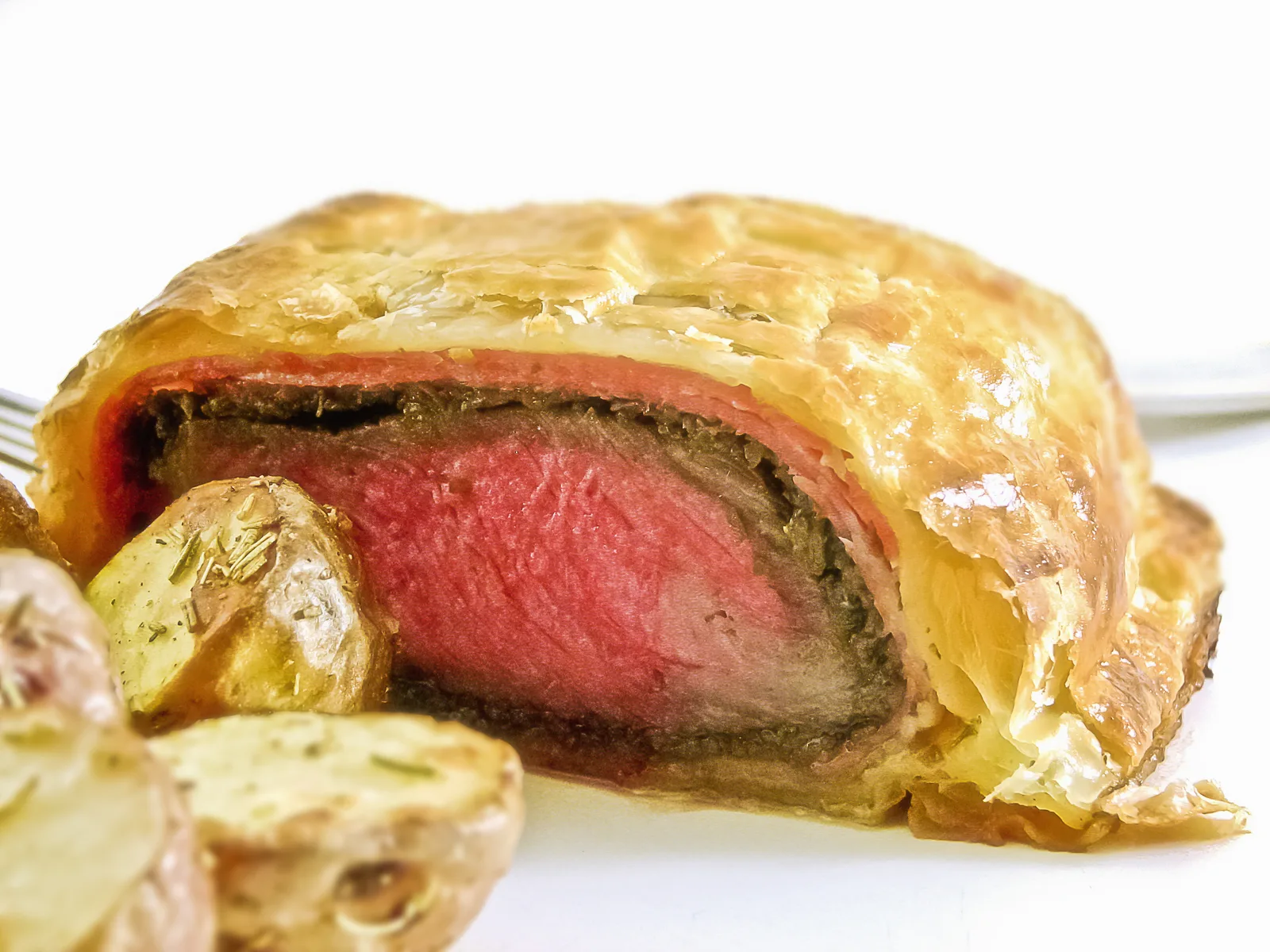
A slice of beef wellington showing pink beef fillet, dark mushroom duxelles and golden puff pastry, with roast potatoes

British Celebration Classic

Photo: Parkerman & Christie, CC BY 2.0, via Wikimedia Commons

The Heritage Formulary

Measured Ingredients

Estimated cost: High — about $12–15 per serving at home (USD)

A true beef wellington has a dry duxelles, a crisp golden crust, and a rosy fillet inside.

Execution Methodology & Culinary Technique

Step-by-Step Cooking Guide

Active 1h 45m
P

Prep Stage: Sear, Duxelles, Chill

60 Mins • Searing and Wrapping

The whole secret of a beef wellington is dryness: sear the fillet hard, cook the mushroom duxelles until it stops steaming, and chill the wrapped parcel before it meets the pastry. Work with cold pastry and a hot oven, and the crust stays crisp instead of soggy.

Maestro Tip: Chill the wrapped fillet for at least 20 minutes — a cold parcel holds its shape in the oven.

  1. 1

    Sear the Fillet

    10 Mins High heat, about 220°C (425°F)

    Season the fillet generously, then sear it in the hot oil for about 2 minutes on each side until deeply browned all over. Brush all over with the Dijon mustard while it is still warm, then leave it to cool.

    Pat the fillet very dry first — moisture stops it browning.

    Done when: A dark, even crust on every side; the centre is still raw.

  2. 2

    Make the Duxelles

    20 Mins Medium heat, about 160°C (320°F)

    Melt the butter and cook the shallots and garlic for 2 minutes, then add the mushroom crumbs, thyme and a pinch of salt. Cook, stirring, for 12–15 minutes until the mushrooms give up their water and the pan is dry — the mixture should hold together and leave no liquid behind.

    If the duxelles is wet, the pastry will be soggy. Keep cooking until a spoon dragged through leaves a clear trail.

    Done when: A dark, dry, paste-like mushroom mixture that holds its shape.

  3. 3

    Wrap in Prosciutto and Chill

    20 Mins Chill in the fridge, 4°C (40°F)

    Lay the prosciutto slices overlapping on a sheet of cling film, spread the cooled duxelles over them in an even layer, and set the fillet on top. Roll it up tightly in the film, twist the ends, and chill for at least 20 minutes.

    The prosciutto layer is a moisture barrier — it is what keeps the pastry crisp.

    Done when: A firm, even cylinder with no gaps in the prosciutto.

  4. 4

    Wrap in Pastry

    10 Mins No heat — cold pastry, 4°C (40°F)

    Roll the cold puff pastry into a rectangle large enough to wrap the fillet with a 2 cm overlap. Unwrap the fillet, set it in the centre, brush the pastry edges with egg wash, and fold it up, sealing the seam underneath. Score the top lightly, brush all over with egg wash, and chill again while the oven heats.

    Keep the pastry cold — warm pastry tears and bakes greasy.

    Done when: A neat parcel with a sealed seam underneath and a glossy egg-washed top.

  5. 5

    Bake Until Golden

    35 Mins 200°C (400°F)

    Bake for about 35 minutes until the pastry is deep golden, puffed and crisp. A thermometer pushed into the centre of the fillet should read at least 63°C (145°F) — the recommended minimum for a whole beef cut — for a medium finish. Many chefs serve it pinker, at 52–55°C (125–130°F), but that is below the recommended minimum temperature.

    If the pastry browns too fast, cover it loosely with foil for the last 10 minutes.

    Done when: Deep golden, crisp pastry; the centre reads 63°C (145°F) or above.

  6. 6

    Rest and Carve

    10 Mins Rest at 60°C (140°F) or above

    Rest for 10 minutes so the juices settle, then carve into thick slices with a sharp serrated knife, using a gentle sawing motion so the pastry does not crush.

    Cutting too soon spills the juices and the pastry goes soft.

    Done when: Clean slices with a rosy centre and crisp pastry that holds its shape.

Finishing Touches & Plating

Serve beef wellington in thick slices, straight from the board, with roast potatoes, green beans and a red wine sauce — the cut face, pink fillet ringed by dark duxelles and golden pastry, is the moment the dish is made for.

Nutritional Physiology & Benefits

Nutrition

Energy

796

kcal / serving

Protein

43g

Complete AA

Carbs

43g

Complex

Fats

50g

Healthy

Per serving (6 servings · 1 serving ≈ 283 g)
Energy796 kcal
Protein43 g
Carbohydrates43 g
Fat50 g
Fibre2.6 g
Sugar2.8 g
Sodium770 mg
Per 100g
Energy281 kcal
Protein15.3 g
Carbohydrates15.2 g
Fat17.6 g
Fibre0.9 g
Sugar1 g
Sodium272 mg

Nutrition values are estimated — calculated from USDA FoodData Central values for the listed ingredients.

Vitamins & minerals: Vitamin B12 and iron (beef fillet), vitamin D and B vitamins (mushrooms), vitamin B6 (garlic, shallots).

High in Protein

Beef fillet is a lean, complete protein — about 43 g per serving — which supports muscle maintenance.

Iron and B12

Beef is rich in iron and vitamin B12, nutrients that support normal red blood cell formation.

A Real Occasion Dish

A whole fillet in pastry turns an ordinary dinner into a celebration — the cooking is the event.

Food Pairings

What to Eat With

To optimize nutrient absorption and elevate the sensory depth, pair with these authentic accompaniments:

Vegetables

Roast Potatoes

Crisp roast potatoes soak up the juices and give the plate a second golden crunch.

Green Beans

Buttered green beans add a fresh, green contrast to the rich pastry and beef.

Drinks

Red Wine Sauce

A simple red wine sauce echoes the beef's richness and keeps each slice moist.

Complete menu

Serve the beef wellington with roast potatoes, buttered green beans and a red wine sauce, and finish with a light dessert such as fruit and cream.

Digestive Guardrails

What NOT to Combine

To prevent digestive distress, sluggishness, or palate clash, avoid pairing the dish with these elements:

A Wet Duxelles

Mushrooms cooked until dry are essential — a wet duxelles soaks the pastry from the inside and the base turns soggy. This is general food guidance, not medical advice.

Carving Too Soon

Cutting the wellington before it rests lets the juices run out and softens the pastry — rest it a full 10 minutes. This is general food guidance, not medical advice.

General information only, not medical advice — consult a doctor for personal dietary decisions.

Who Should Eat It

Who Should Eat

  • General adultsA rich celebration dish for adults — one slice with vegetables is a full meal.
  • ChildrenChildren can enjoy a small slice, but the flavours are grown-up and the dish is rich.
  • ElderlyTender and easy to chew once sliced; keep the portion modest because it is rich.
  • Pregnant womenGenerally fine in a modest portion, but it is rich and salty — check with your clinician.
  • Breastfeeding womenFine in a modest portion; the iron and protein support recovery.
  • AthletesA strong celebration meal — high in protein, with roast potatoes for energy.
  • Weight gainAn easy way to add energy — a generous slice with roast potatoes and extra sauce.
  • Weight lossBest enjoyed rarely and in a small slice — it is high in fat, salt and calories.

Health Conditions — Adjust or Avoid

Conditions

  • DiabetesPuff pastry is starchy and the dish is rich — a small slice only, and check with your clinician.
  • High blood pressureProsciutto and pastry are salty — keep the slice small and check with your clinician.
  • Kidney diseaseHigh in protein and potassium; keep portions small and ask your clinician.
  • GoutBeef is moderately high in purines — eat occasionally and in a smaller portion.
  • Stomach issuesRich pastry and mushrooms can be heavy; a small slice with plain vegetables is gentlest.
  • Cardiovascular diseaseHigh in saturated fat — use a small slice and plenty of vegetables.
  • Fatty liverA rich dish — enjoy occasionally, in a small slice with vegetables.
  • Food allergiesContains wheat (gluten), milk (butter, pastry), egg, and pork (prosciutto). Check every label if you have an allergy.
  • Special therapeutic dietsIf you follow a prescribed low-fat or low-salt diet, this dish does not fit it — ask your clinician for a suitable alternative.

If you have a medical condition, consult your doctor before changing your diet.

Storage & Use

Storage & Use

How to store
Cool quickly and store slices in a covered container in the fridge.
In the fridge
Beef wellington keeps 2 days in the fridge at 4°C (40°F) or below.
In the freezer
Freezes for up to 1 month, wrapped airtight; the pastry softens on thawing. Thaw overnight in the fridge.
How to reheat
Reheat slices in the oven at 180°C (350°F) for 10–12 minutes until steaming hot, to 74°C (165°F); the pastry will not be as crisp as fresh.
Freezing recommended
Only if needed — the pastry is best fresh, and freezing softens it.
Signs it has spoiled
Sour smell, slimy pastry, or grey, dull meat.

More recipes to explore

Golden battered fish on thick-cut chips in a takeaway tray United Kingdom flag United Kingdom 50m
Dinner •British Seaside Classic

Fish and Chips

Fish and chips is Britain's seaside icon: thick cod fillets in a crisp beer batter, fried golden, served with fat hand-cut chips, salt, malt vinegar and lemon. One serving is about 400 g.

Comfort & Satisfaction

Crisp beer-battered cod with golden thick-cut chips and lemon.

Pairs Well With
Mushy peas, tartar sauce and a wedge of lemon
High Protein
A golden shepherd's pie in a baking dish with a crisp mashed potato top United Kingdom flag United Kingdom 1h 20m
Dinner •British Farmhouse Classic

Shepherd's Pie

Shepherd's pie is Britain's great farmhouse bake: minced lamb simmered with onion, carrot and peas in a rich gravy, topped with buttery mashed potato and Cheddar, then baked until the top turns crisp and golden. One serving is about 350 g.

Comfort & Warmth

Rich lamb and vegetables under a golden cheesy mashed-potato crust.

Pairs Well With
Buttered green peas or steamed green beans on the side
High Protein
A full English breakfast plate with beans, fried egg, tomato, mushrooms, sausage and bacon United Kingdom flag United Kingdom 35m
Breakfast •British Breakfast Classic

Full English Breakfast

The Full English is Britain's great fry-up: pork sausages, back bacon, fried eggs, black pudding, baked beans, mushrooms and grilled tomato, with buttered toast on the side — all cooked in one pan and eaten hot. One serving is about 450 g.

Hearty & Filling

Sausages, bacon, eggs, black pudding, beans, mushrooms and tomato on one plate.

Pairs Well With
Buttered toast and a strong cup of tea
High Protein
A plate of roast beef with a large Yorkshire pudding, roast potatoes, peas, carrots and cabbage on a wooden pub table United Kingdom flag United Kingdom 2h 40m
Dinner •English Sunday Roast

Roast Beef with Yorkshire Pudding

A topside joint roasted until blushing pink, served with golden Yorkshire puddings risen in beef dripping, crisp roast potatoes, carrots and peas, and a proper pan gravy. This roast beef with yorkshire pudding recipe is the full Sunday spread, built for a slow afternoon and a full table. One serving is about 660 g.

Comfort & Warmth

Pink roast beef, towering Yorkshire puddings, crisp roast potatoes and rich gravy — the Sunday dinner Britain is famous for.

Pairs Well With
Horseradish sauce, roast potatoes & a glass of red wine
High Protein

The Dinner Gazette

Never wonder what’s for dinner again

One email a week with easy dinner ideas from around the world — ingredients, steps and nutrition, tested in our kitchen first.

Delivered every Thursday morning. Unsubscribe anytime.