
Curated recipes from 193 countries  •  New seasonal Mediterranean issue out now

Overview

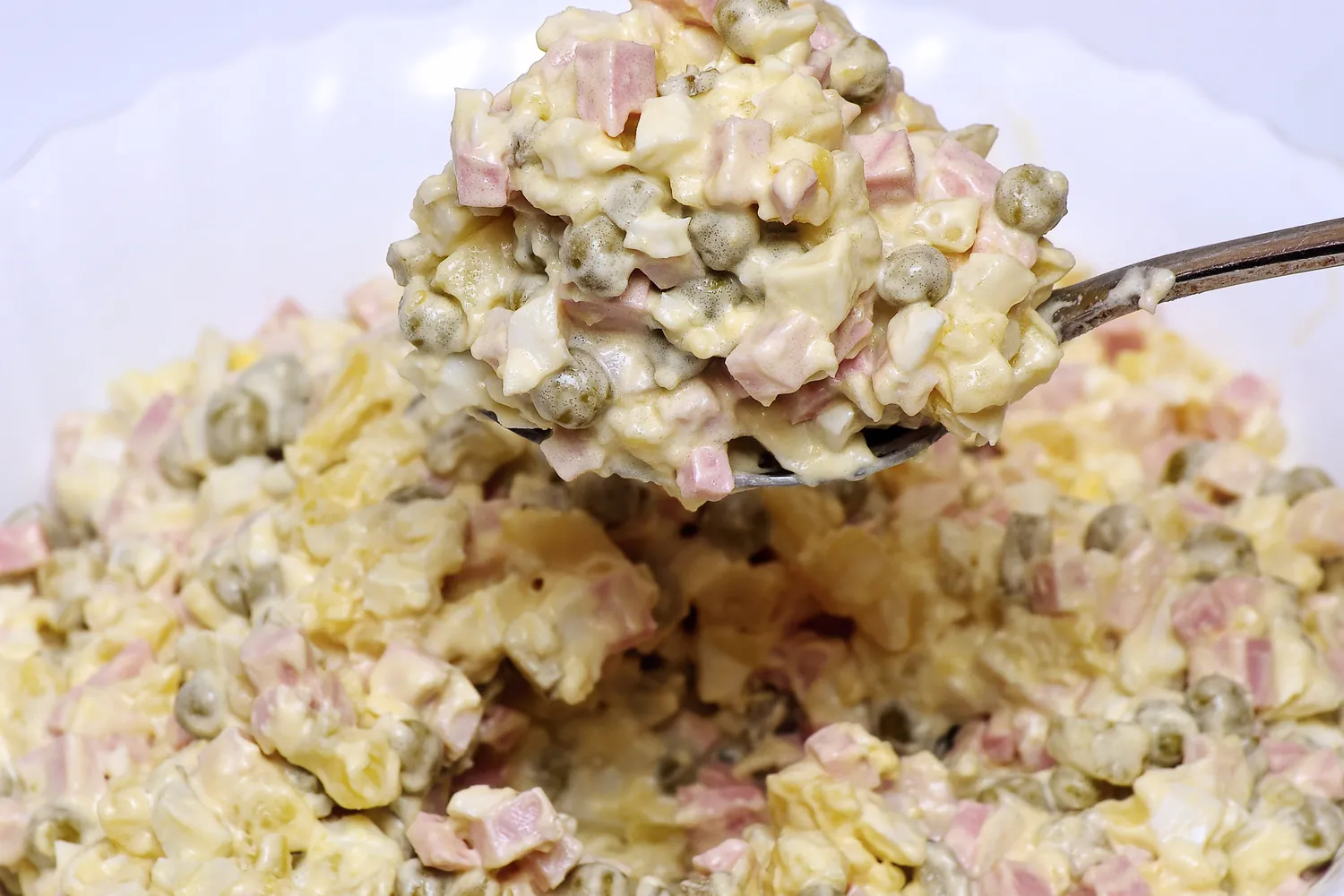
Olivier Salad

Russian Olivier Salad, Salat Olivye, Ensalada Rusa

This olivier salad recipe dices waxy potatoes, carrots, peas, dill pickles, hard-boiled eggs and cooked ham into small even cubes, then folds them through creamy mayonnaise with a little mustard and fresh dill. It is the cold, make-ahead salad at the centre of Russian holiday tables. One serving is about 306 g.

Olivier salad was created in the 1860s by Lucien Olivier, a Belgian chef at the Hermitage restaurant in Moscow. His original recipe was a closely guarded secret, and the version that spread across Russia in the Soviet era — diced potatoes, carrots, peas, pickles, eggs and mayonnaise, often with chicken or bologna — became the salad of New Year and holiday tables, a place it still holds today.

Pairs well with: Diced ham, pickles & creamy mayonnaise

Provenance

Russia flag Russia

Russian Heritage

Nordic & European

Time Dedication

1h

35m prep • 25m cook

Batch Yield

6 Servings

440 kcal per serving

1 serving ≈ 306 g

Technical Skill

Easy

Easy (One Pot)

Meal Timing & Digestive Fit

Breakfast

Not Advised

Lunch

Prime Metabolic Fit

Dinner

Ideal Hearty Main

Snack & Tea

Inappropriate

Occasions: New Year, holiday tables, family lunches, picnics, zakuski spreads Cost: Low — about $3–4 per serving at home
A spoonful of Olivier salad with diced ham, green peas, potato and egg in creamy mayonnaise over a white bowl

Russian Heritage

Photo: Pannet, CC BY-SA 4.0, via Wikimedia Commons

The Heritage Formulary

Measured Ingredients

Estimated cost: Low — about $3–4 per serving at home (USD)

Made the classic Soviet-era way: everything diced small and even, folded through mayonnaise, and served well chilled.

Execution Methodology & Culinary Technique

Step-by-Step Cooking Guide

Active 1h
P

Prep Stage: Boil & Dice

35 Mins • Boiling & Dicing

Put the potatoes, carrots and eggs on to boil first — everything else is dicing while they cool. Have a large bowl ready for mixing, and keep the mayonnaise cold until the diced vegetables are fully cool, or the dressing will turn oily.

Maestro Tip: Cut everything to the size of a pea — even cubes are what make an Olivier salad look and taste right.

  1. 1

    Boil the Potatoes, Carrots & Eggs

    25 Mins Boiling, 100°C (212°F)

    Put the unpeeled potatoes and the carrots in a large pot, cover with cold salted water and boil for about 20 minutes, until a knife slips in easily. Add the eggs for the last 10 minutes of boiling so they turn hard-boiled, and add the peas for the last 3 minutes.

    Start the vegetables in cold water so they cook evenly from the outside in.

    Done when: Potatoes tender but still holding their shape; eggs hard-boiled.

  2. 2

    Cool, Peel & Dice

    20 Mins Cool, 20°C (68°F)

    Drain the vegetables and eggs and leave them until cool enough to handle. Peel the potatoes, carrots and eggs, then dice everything — potatoes, carrots, eggs, ham and pickles — into small, even cubes about the size of a pea, and tip them into a large bowl with the peas and finely chopped onion.

    Dice while the potatoes are just warm, not hot — hot potato drinks up the mayonnaise and turns the salad greasy.

    Done when: A bowl of small, even cubes with nothing mushy.

  3. 3

    Fold in the Mayonnaise

    10 Mins Chilled, 4°C (40°F)

    Add the mayonnaise, mustard, chopped dill and salt to the bowl and fold gently with a large spoon until every cube is coated. Taste and adjust the salt — the pickles and ham already bring plenty.

    Fold, do not stir hard — rough stirring breaks the potato cubes and turns the salad to mash.

    Done when: Every cube glossy with dressing, the salad holding together in soft spoonfuls.

  4. 4

    Chill & Serve

    5 Mins Chilled, 4°C (40°F)

    Cover the bowl and chill for at least 30 minutes so the flavours settle, then serve cold in a bowl or moulded on a plate, with extra dill on top.

    Olivier salad tastes better the next day — make it the evening before a holiday and chill overnight.

    Done when: Cold right through, creamy and well seasoned.

Finishing Touches & Plating

Serve the Olivier salad cold, straight from the fridge, with a little extra dill scattered over the top — it is at its best after a night in the fridge, when the pickles and mustard have seasoned the mayonnaise.

Nutritional Physiology & Benefits

Nutrition

Energy

440

kcal / serving

Protein

14g

Complete AA

Carbs

32g

Complex

Fats

29g

Healthy

Per serving (6 servings · 1 serving ≈ 306 g)
Energy440 kcal
Protein14 g
Carbohydrates32 g
Fat29 g
Fibre5.3 g
Sugar6.0 g
Sodium1105 mg
Per 100g
Energy144 kcal
Protein4.7 g
Carbohydrates10.3 g
Fat9.3 g
Fibre1.7 g
Sugar2 g
Sodium361 mg

Nutrition values are estimated — calculated from USDA FoodData Central values for the listed ingredients.

Vitamins & minerals: Potatoes and carrots supply vitamin C and potassium, peas add fibre and plant protein, and the eggs add vitamin B12 and vitamin D. All nutrition values are estimated.

Steady, Filling Energy

About 440 kcal a serving with 31.5 g of carbohydrate from potatoes, carrots and peas makes a filling lunch that keeps well.

Protein from Egg & Ham

The eggs and ham together give about 14.4 g of protein per serving.

Fibre & Colour from Vegetables

Peas, carrots and pickles add fibre, vitamin C and potassium to the bowl.

Food Pairings

What to Eat With

To optimize nutrient absorption and elevate the sensory depth, pair with these authentic accompaniments:

Sides

Dark Rye Bread

Dense rye bread is the classic partner — its sour crumb stands up to the creamy salad and is perfect for scooping.

Vegetables

Pickled Cucumbers

Extra pickles on the side sharpen the rich mayonnaise and echo the pickles inside the salad.

Drinks

Chilled Kvass or Beer

A cold, lightly sour drink cuts through the creamy dressing and suits a holiday table.

Full Menus

Smoked Fish & Cold Meats

Olivier salad sits at the heart of a Russian zakuski spread, next to smoked fish and cold meats that share its salty, savoury character.

Complete menu

Serve the Olivier salad cold with dark rye bread, extra pickles and smoked fish, as part of a holiday zakuski spread.

Digestive Guardrails

What NOT to Combine

To prevent digestive distress, sluggishness, or palate clash, avoid pairing the dish with these elements:

Leaving It Out Warm

Mayonnaise salads spoil quickly at room temperature — do not leave the bowl out for more than 2 hours, and keep it chilled until serving. This is general food information, not medical advice.

Extra Salt at the Table

One serving already carries about 1,105 mg of sodium from the ham, pickles and mayonnaise, so do not add more salt. This is general food information, not medical advice.

General information only, not medical advice — consult a doctor for personal dietary decisions.

Who Should Eat It

Who Should Eat

  • General adultsA rich, filling lunch — about 440 kcal a serving, best in a modest portion with bread and pickles.
  • ChildrenMild, soft and easy to eat; children usually pick out the peas and ham first.
  • ElderlySoft, easy to chew and served cold; keep the portion modest if salt is a concern.
  • Pregnant womenFine as a lunch, as long as the eggs are fully hard-boiled and the salad is kept chilled. Ask your clinician about portions.
  • Breastfeeding womenA filling, energy-rich lunch; the eggs, ham and vegetables supply protein, carbohydrate and vitamins.
  • AthletesA good carbohydrate-rich lunch — about 31.5 g of carbohydrate per serving; add an extra egg for more protein.
  • Weight gainA good choice for adding energy: the full plate with mayonnaise and ham is filling and calorie-dense.
  • Weight lossKeep to a small scoop with extra pickles and vegetables, and lighten the dressing with half yoghurt.

Health Conditions — Adjust or Avoid

Conditions

  • DiabetesPotatoes and peas are starchy, so keep the scoop modest and load the plate with pickles and salad vegetables. Ask your clinician about portions.
  • High blood pressureThe ham, pickles and mayonnaise make this salad salty — eat it occasionally and in a modest portion. Ask your clinician.
  • Kidney diseaseHigh in sodium and protein from the ham and pickles; ask your clinician before eating it.
  • GoutHam is rich in purines, so skip the ham and keep to the vegetable version if gout is a concern. Ask your clinician.
  • Stomach issuesCold, creamy and rich — the pickles and onion can be hard on a sensitive stomach. Ask your clinician.
  • Cardiovascular diseaseMayonnaise and ham add saturated fat and sodium — a modest portion now and then is wiser. Ask your clinician.
  • Fatty liverThe dressing is rich; keep the portion modest and go easy on the mayonnaise. Ask your clinician.
  • Food allergiesContains egg (mayonnaise and hard-boiled eggs), mustard and pork. The dressing contains egg, so it is not egg-free.
  • Special therapeutic dietsNot vegetarian as written — leave out the ham for a meat-free version, and use a dairy-free mayonnaise if needed.

If you have a medical condition, consult your doctor before changing your diet.

Storage & Use

Storage & Use

How to store
Cool quickly and store in an airtight container in the fridge.
In the fridge
Keeps 2 days in the fridge at 4°C (40°F) or below; do not leave out at room temperature for more than 2 hours.
In the freezer
Not recommended — the mayonnaise splits and the potatoes turn grainy.
How to reheat
Do not reheat — this salad is served cold.
Freezing recommended
No — freezing spoils the texture of the dressing and potatoes.
Signs it has spoiled
Sour or sharp smell, watery dressing, or a slimy surface.

More recipes to explore

Beef stroganoff, strips of beef in a creamy mushroom sauce with parsley, on a black plate Russia flag Russia 50m
Dinner •Russian Heritage

Beef Stroganoff

This beef stroganoff recipe sears strips of beef tenderloin until browned, simmers them with mushrooms and onion in a rich stock, and finishes the sauce with sour cream and mustard. It is the Russian classic that travelled the world, and it is best served over buttered egg noodles. One serving is about 370 g, sauce and noodles together.

Comfort & Warmth

Tender beef strips in a creamy mushroom sauce, served over egg noodles.

Pairs Well With
Buttered egg noodles and a crisp cucumber salad.
High Protein
A red plate of cooked Russian pelmeni dumplings with sour cream and chopped green onion, with radishes beside it Russia flag Russia 1h 25m
Dinner •Russian Heritage

Pelmeni

This pelmeni recipe wraps a juicy filling of minced beef and pork in thin wheat dough, pinched into little ear shapes, and boils the dumplings in a light beef broth. Unlike pierogi, which are filled with potato and cheese and fried in butter, pelmeni are meat dumplings served in their hot cooking broth with sour cream and dill. One serving is about 450 g, dumplings, broth and sour cream together.

Comfort & Warmth

Small meat dumplings in thin dough, boiled and served in hot broth with sour cream.

Pairs Well With
Sour cream and fresh dill, with a spoonful of the hot broth.
High Protein
Rolled Russian blini pancakes with berry sauce, icing sugar and mint on a white plate, with a teapot and cup Russia flag Russia 1h 40m
Breakfast •Russian Heritage

Blini

This blini recipe makes thin, golden pancakes from a yeasted batter, fried one by one in butter until lacy at the edges. Blini are Russia's celebration pancake, eaten at breakfast with sour cream, jam and honey, or rolled up with sweet fillings. One serving is about 300 g, six blini with toppings.

Comfort & Warmth

Golden yeasted pancakes, thin and lacy, served with sour cream, jam and honey.

Pairs Well With
Sour cream, strawberry jam and honey, with hot tea.
Tagliatelle al ragù Bolognese in a bowl with Parmigiano-Reggiano Italy flag Italy 4h 25m
Lunch •Emilia-Romagna

Tagliatelle al Ragù Bolognese

Slow-braised soffritto and coarse ground heritage meats layered over handmade egg yolk dough for mid-day stamina.

Lean Protein

Slow-simmered beef ragù tossed through fresh egg tagliatelle.

Pairs Well With
Bitter Radicchio & Aged Balsamico di Modena
Pasta & Noodles • High Protein

The Dinner Gazette

Never wonder what’s for dinner again

One email a week with easy dinner ideas from around the world — ingredients, steps and nutrition, tested in our kitchen first.

Delivered every Thursday morning. Unsubscribe anytime.