Curated recipes from 193 countries  •  New seasonal Mediterranean issue out now

Overview

Saumagen

Pfälzer Saumagen; Palatinate Stuffed Pork Stomach

Saumagen is the Palatinate's most famous dish: a cleaned pork stomach stuffed with diced pork shoulder, minced pork, boiled potatoes, onion and marjoram, simmered gently for three hours, then sliced and pan-fried until the edges turn crisp and golden. This saumagen recipe follows the traditional method published from Hannelore Kohl's kitchen, served the classic way with sauerkraut. One serving is about 488 g — two thick fried slices.

Saumagen is the signature dish of the Palatinate (Pfalz) in south-west Germany, created by farmhouse butchers as a way to use the whole pig — the stomach became the casing for a stuffing of pork, potatoes and marjoram. It became famous far beyond the region when Chancellor Helmut Kohl served it to visiting heads of state, including Margaret Thatcher, Mikhail Gorbachev and Ronald Reagan, at his home in Oggersheim and in Deidesheim. Hannelore Kohl's recipe for the dish has been widely published, and it remains the dish the Palatinate is proudest of.

Pairs well with: Braised sauerkraut, mashed potatoes & a glass of dry Riesling

Provenance

Germany flag Germany

Palatinate Classic

Nordic & European

Time Dedication

4h 25m

45m prep • 220m cook

Batch Yield

4 Servings

808 kcal per serving

1 serving ≈ 488 g

Technical Skill

Advanced

Advanced (Stuff & Simmer)

Meal Timing & Digestive Fit

Breakfast

Not Advised

Lunch

Hearty Midday Main

Dinner

Ideal Hearty Main

Snack & Tea

Inappropriate

High Protein Occasions: Hearty family dinners, cold-weather weekends, German food nights, festive gatherings Cost: Low — about $3–4 per serving at home
Two golden-brown pan-fried slices of Saumagen with sauerkraut and parsley on a white plate

Palatinate Classic

Photo: Benreis, CC BY 3.0, via Wikimedia Commons

The Heritage Formulary

Measured Ingredients

Estimated cost: Low — about $3–4 per serving at home (USD)

A good Saumagen slices cleanly, shows distinct cubes of pork and potato, smells of marjoram, and fries up crisp at the edges without falling apart.

Execution Methodology & Culinary Technique

Step-by-Step Cooking Guide

Active 4h 25m
P

Prep Stage: Soak, Dice & Mix

45 Mins • Knife Work

Soak the cleaned pork stomach in cold salted water while you work. Boil the potatoes the day before so they are cold and firm — warm potatoes crumble into the filling. Dice the pork shoulder and the cold potatoes into neat 1 cm cubes, sauté the onion in butter until pale gold, then mix everything with the minced pork, beaten eggs, parsley and spices until it just holds together. Have kitchen string, a large needle and your biggest pot ready before you start stuffing.

Maestro Tip: Keep the filling cold and do not overmix — a loose, chunky mix slices cleanly, a worked paste turns rubbery.

  1. 1

    Clean and Soak the Stomach

    30 Mins Cold water, about 10°C (50°F)

    Rinse the cleaned pork stomach under cold running water, inside and out, then soak it in a bowl of cold salted water for 30 minutes and rinse again. Tie two of its three openings shut with kitchen string, leaving the widest opening for filling. Check for any thin spots or small holes and sew them closed with the needle and string.

    A butcher-cleaned stomach saves an hour of scraping; if yours still smells at all, soak it in water with a splash of vinegar and rinse again.

    Done when: Pale, elastic, odourless stomach with two openings tied shut.

  2. 2

    Mix the Filling

    15 Mins Room temperature, about 20°C (68°F)

    Put the 500 g of diced pork shoulder, 300 g of minced pork and 500 g of diced boiled potatoes in a large bowl. Add the sautéed onion, the crushed garlic, the 2 beaten eggs, the chopped parsley, the marjoram, nutmeg, white pepper and the 12 g of salt. Mix with your hands just until everything is evenly combined and the mixture holds together when squeezed.

    Fry a teaspoon of the filling in a pan and taste it now — this is your only chance to fix the seasoning.

    Done when: A chunky, even mixture that holds together when squeezed in your fist.

  3. 3

    Stuff and Sew the Stomach

    10 Mins Room temperature, about 20°C (68°F)

    Spoon the filling into the stomach through the open end, pressing it in gently with the back of a spoon. Fill it only about three-quarters full — the potatoes swell as they cook and an overfilled stomach bursts. Sew the last opening shut with kitchen string, then prick the stomach in a few places with a needle so steam can escape.

    Three-quarters full is the rule: a burst stomach in the pot cannot be saved.

    Done when: A plump but soft parcel, sewn shut, that still gives a little when pressed.

  4. 4

    Simmer Gently — Never Boil

    3 Hours Gentle simmer, 75–80°C (167–176°F)

    Lower the stuffed stomach into the 3 litres of lightly salted water in a large pot. Heat slowly until the water just trembles at 75–80°C (167–176°F) — it must never reach a rolling boil, or the stomach will burst. Simmer gently for 3 hours, turning the stomach once halfway through and topping up with hot water if the level drops. The filling must reach at least 71°C (160°F) right through; after 3 hours at this temperature it will be well past that.

    If you see the water starting to bubble hard, pull the pot off the heat at once and let it settle back to a tremble.

    Done when: The stomach feels firm and springy, and a skewer pushed into the centre comes out hot; the filling is cooked through to at least 71°C (160°F).

  5. 5

    Rest and Slice

    30 Mins Rest at room temperature, about 20°C (68°F)

    Lift the Saumagen out of the pot with two large spoons and let it rest on a board for 30 minutes. Resting lets the filling set, so the slices hold together. Cut the stomach into slices about 2 cm thick with a long, sharp knife, wiping the blade between cuts.

    Do not slice it hot — a hot Saumagen crumbles, a rested one cuts into clean, handsome rounds.

    Done when: Clean 2 cm slices showing pork, potato and marjoram flecks all the way through.

  6. 6

    Pan-Fry the Slices Until Crisp

    10 Mins Medium-high heat, about 190°C (375°F)

    Melt the remaining 20 g of butter in a large frying pan over medium-high heat. Fry the slices in a single layer for 4–5 minutes per side until deep golden and crisp at the edges. The slices must be steaming hot all the way through — reheat to 74°C (165°F) — before serving.

    Do not crowd the pan: fry in batches so the slices crisp instead of steaming.

    Done when: Deep golden, crisp-edged slices, steaming hot through to 74°C (165°F).

Finishing Touches & Plating

Serve two fried slices per person with braised sauerkraut and mashed potatoes, and a spoonful of sharp mustard on the side. Eat it while the edges are still crisp — that contrast between the crackling crust and the soft, marjoram-scented filling is the whole point of the dish.


Nutritional Physiology & Benefits

Nutrition

Energy

808

kcal / serving

Protein

57g

Complete AA

Carbs

30g

Complex

Fats

49g

Healthy

Per serving (4 servings · 1 serving ≈ 488 g)
Energy808 kcal
Protein57 g
Carbohydrates30 g
Fat49 g
Fibre3.2 g
Sugar2.9 g
Sodium1460 mg
Per 100g
Energy166 kcal
Protein11.8 g
Carbohydrates6.1 g
Fat10.1 g
Fibre0.6 g
Sugar0.6 g
Sodium299 mg

Nutrition values are estimated — calculated from USDA FoodData Central values for the listed ingredients.

Vitamins & minerals: B vitamins, especially B1, B6 and B12 (pork), iron and zinc (pork), vitamin C and potassium (potatoes), vitamin K (parsley).

Serious Staying Power

About 57 g of protein and 808 kcal per serving make this one of the most filling dinners on the site — a single plate carries you for hours.

B Vitamins and Iron

Pork is a strong source of vitamin B1, B6 and B12, plus iron and zinc, and the potatoes add potassium and vitamin C.

No Additives, Just Pork and Potato

The filling is simply meat, potato, onion, egg and spice — no breadcrumbs, no fillers, nothing you cannot pronounce.

Food Pairings

What to Eat With

To optimize nutrient absorption and elevate the sensory depth, pair with these authentic accompaniments:

Vegetables

Braised Sauerkraut

Sharp, tangy sauerkraut cuts through the rich pork fat and resets the palate between bites — the classic Palatinate pairing for a reason.

Sides

Mashed Potatoes

Soft mashed potatoes soak up the buttery pan juices from the fried slices and turn the plate into a proper hearty dinner.

Drinks

Dry Riesling

A dry Palatinate Riesling has the acidity to slice through pork fat and the fruit to stand up to the marjoram and nutmeg.

Sauces

Sharp Mustard

A spoonful of sharp mustard adds heat and vinegar bite that lifts the rich, mild filling without overpowering it.

Complete menu

Start with the fried Saumagen slices as the main plate, with braised sauerkraut and mashed potatoes on the side and sharp mustard on the table; finish with a glass of dry Riesling.

Digestive Guardrails

What NOT to Combine

To prevent digestive distress, sluggishness, or palate clash, avoid pairing the dish with these elements:

Sweet Sauces or Ketchup

Sweet sauces clash with the marjoram and nutmeg and bury the pork flavour; mustard or sauerkraut give the sharpness this dish wants instead. This is general information, not medical advice.

Boiling the Stomach Hard

A rolling boil bursts the stomach and spills the filling into the pot — keep the water at a gentle tremble, never a boil, for the whole three hours. This is general information, not medical advice.

General information only, not medical advice — consult a doctor for personal dietary decisions.

Who Should Eat It

Who Should Eat

  • General adultsA rich, very filling dinner — two slices with sauerkraut is a full plate; save it for a hungry evening, not a light lunch.
  • ChildrenSuitable for older children in small portions, with the fried edges cut off if they find them too crisp; the flavour is mild and not spicy.
  • ElderlyBest in a small portion with soft sauerkraut and mashed potatoes; the fried slices are rich and the sodium is high, so keep it occasional.
  • Pregnant womenGenerally suitable when the filling is cooked right through to at least 71°C (160°F) and the slices are served steaming hot; keep portions moderate. Ask your clinician if unsure.
  • Breastfeeding womenGenerally suitable; the protein and iron are useful, though the dish is salty and very rich, so keep portions moderate.
  • AthletesA strong post-training meal: about 57 g of protein and 30 g of carbohydrate per serving for recovery and glycogen.
  • Weight gainA good choice — add a third slice and a full helping of mashed potatoes with butter.
  • Weight lossKeep to one slice with plenty of sauerkraut and a salad instead of mashed potatoes; the dish is energy-dense at 808 kcal per serving.

Health Conditions — Adjust or Avoid

Conditions

  • DiabetesAbout 30 g of carbohydrate per serving comes mostly from the potatoes, so plan the portion and skip the mashed potatoes on the side; ask your clinician about portions.
  • High blood pressureSodium is about 1,460 mg per serving, so this is an occasional dish, not a regular one; load the plate with sauerkraut rather than extra slices, and ask your clinician about your target.
  • Kidney diseaseThe protein (about 57 g) and sodium are both high, so keep portions small if you follow a protein or sodium limit, and ask your clinician.
  • GoutPork and offal are high in purines, so eat this occasionally and in a small portion if you manage uric acid; ask your clinician if unsure.
  • Stomach issuesThe fried slices and rich pork fat can feel heavy; eat slowly, in a small portion, with sauerkraut, and skip the fried edges if your stomach is sensitive, and ask your clinician if unsure.
  • Cardiovascular diseaseSaturated fat is high (about 49 g of fat per serving, much of it saturated), so treat Saumagen as an occasional celebration dish, and ask your clinician about your overall diet.
  • Fatty liverKeep the portion to one slice with sauerkraut and no mashed potatoes; the pork fat adds up quickly, and ask your clinician if you follow a prescribed diet.
  • Food allergiesContains egg and pork. Naturally gluten-free and dairy-free apart from the butter — use lard instead of butter if you avoid dairy, and check your mustard label.
  • Special therapeutic dietsFits a gluten-free diet as written; for a low-sodium plan, halve the salt in the filling and serve one slice with unsalted sauerkraut, and check with your clinician.

If you have a medical condition, consult your doctor before changing your diet.

Storage & Use

Storage & Use

How to store
Cool the whole Saumagen completely, then wrap tightly in cling film and store in the fridge; slice only what you need.
In the fridge
Whole or sliced, 3 days in the fridge at 4°C (40°F) or below.
In the freezer
Sliced, up to 2 months in a sealed bag, layered with baking paper.
How to reheat
Pan-fry slices in a little butter over medium heat until crisp and steaming hot all the way through, to 74°C (165°F); do not microwave, or the edges turn rubbery.
Freezing recommended
Yes — slices freeze well and fry up crisp from thawed.
Signs it has spoiled
Sour or off smell, slimy surface, or any grey-green discolouration on the slices.

More recipes to explore

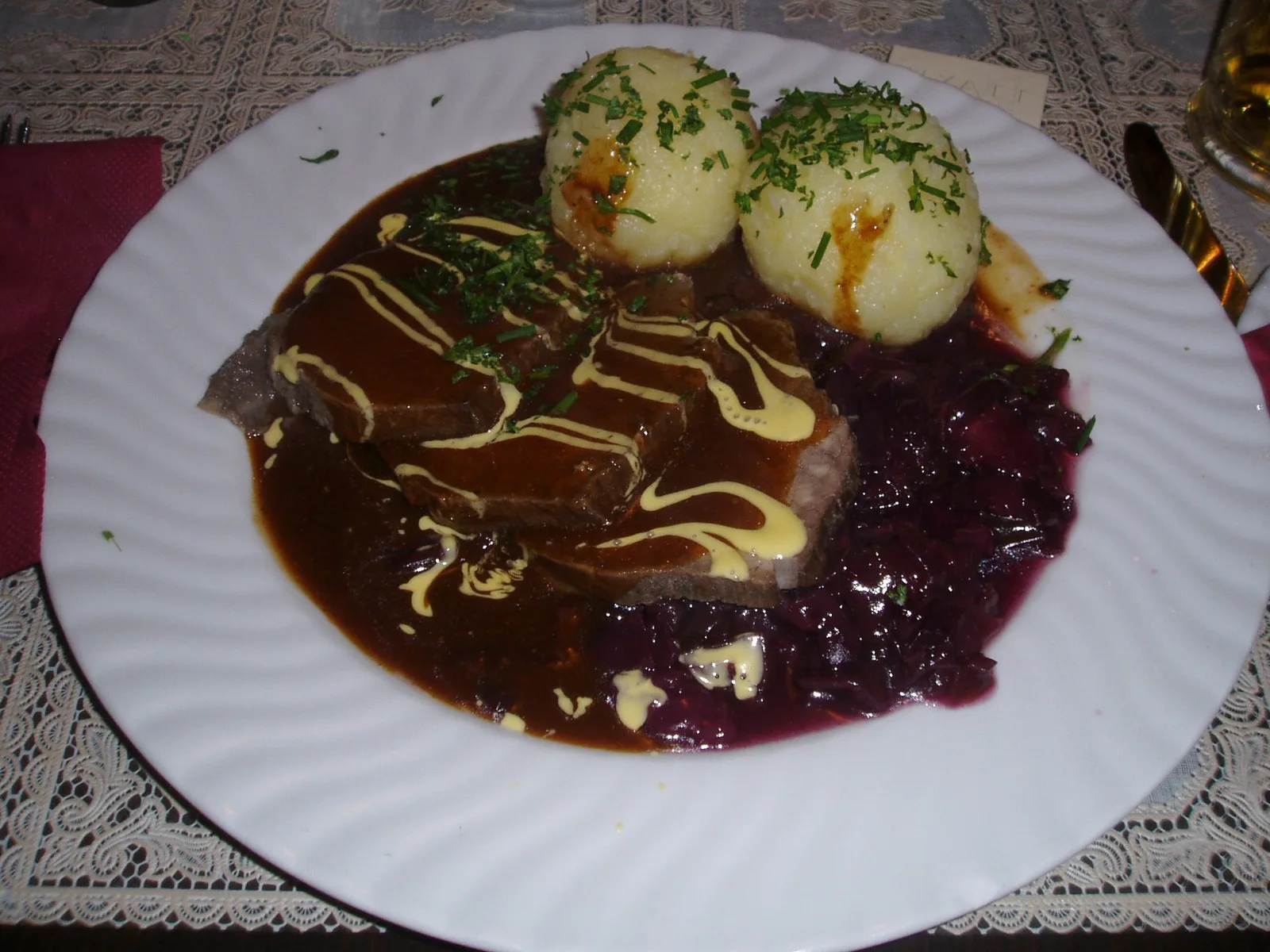
Sliced sauerbraten in dark sweet-sour gravy with potato dumplings and braised red cabbage on a white plate Germany flag Germany 3h 30m
Dinner •Rhineland Heritage

Sauerbraten

This sauerbraten recipe starts with a beef chuck roast steeped for three days in red wine vinegar, red wine and warm spices, then braised slowly until it slices like butter. The marinade becomes a dark, sweet-sour gravy thickened with crushed gingersnaps and studded with raisins, the Rhineland way. One serving is about 300 g, with gravy.

Comfort & Warmth

A slow-braised German pot roast in a sweet-sour vinegar gravy, sliced thick and served hot with potato dumplings and red cabbage.

Pairs Well With
Potato dumplings, braised red cabbage & a glass of Spätburgunder
High Protein
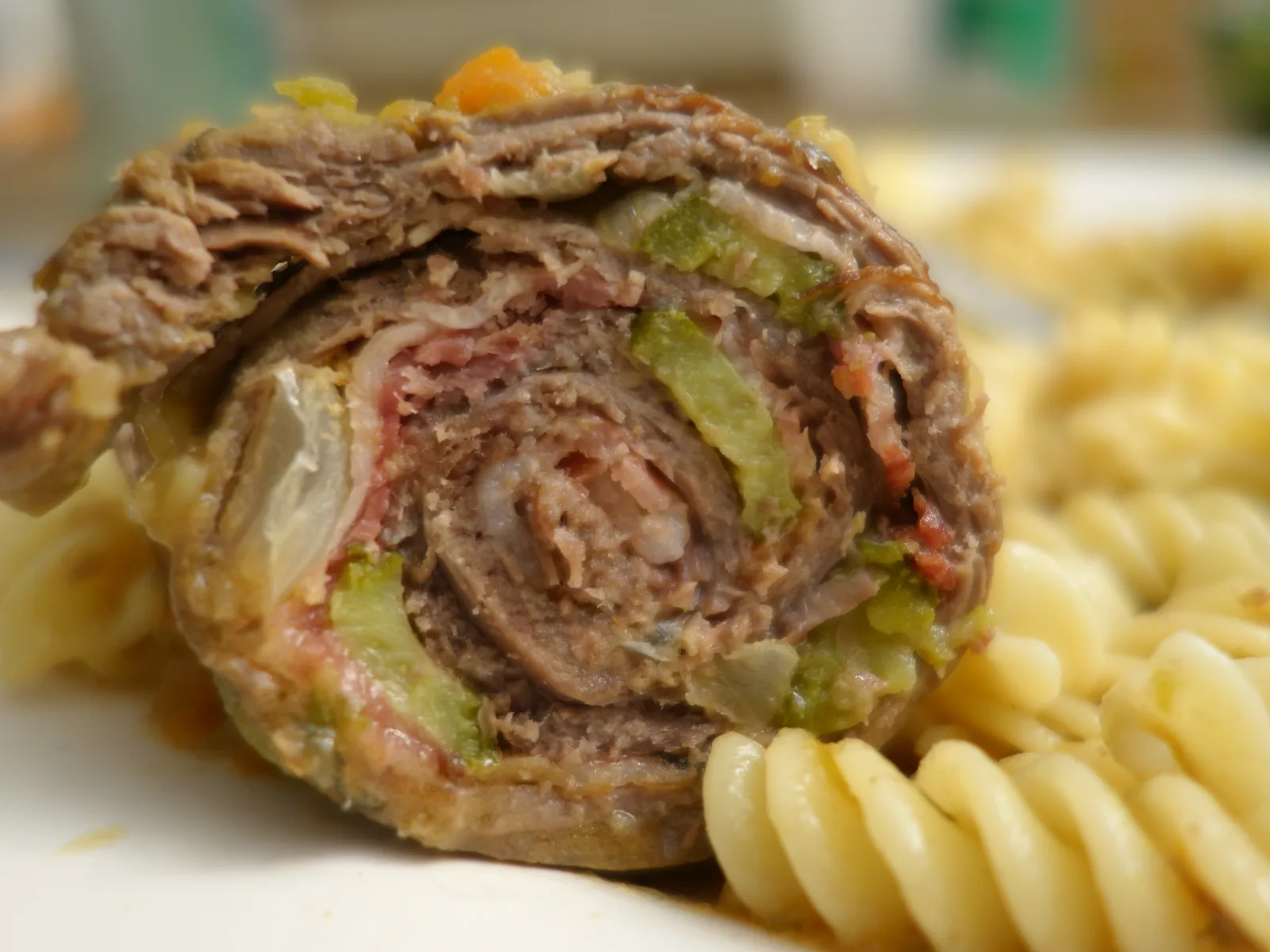
A sliced German beef roulade showing the spiral of beef, bacon and dill pickle, served with pasta Germany flag Germany 2h 10m
Dinner •German Sunday Heritage

Rouladen

This rouladen recipe spreads thin slices of top round with mustard, then rolls them around smoky bacon, dill pickles and onion into neat parcels. The rolls are browned, then braised slowly in red wine and beef stock until tender, and the braising liquid becomes a rich gravy. One serving is about 375 g — two rolls with gravy.

Comfort & Warmth

Thin beef rolls stuffed with bacon, dill pickle and onion, braised in red wine gravy and served hot with dumplings.

Pairs Well With
Potato dumplings, braised red cabbage & a German lager
High Protein
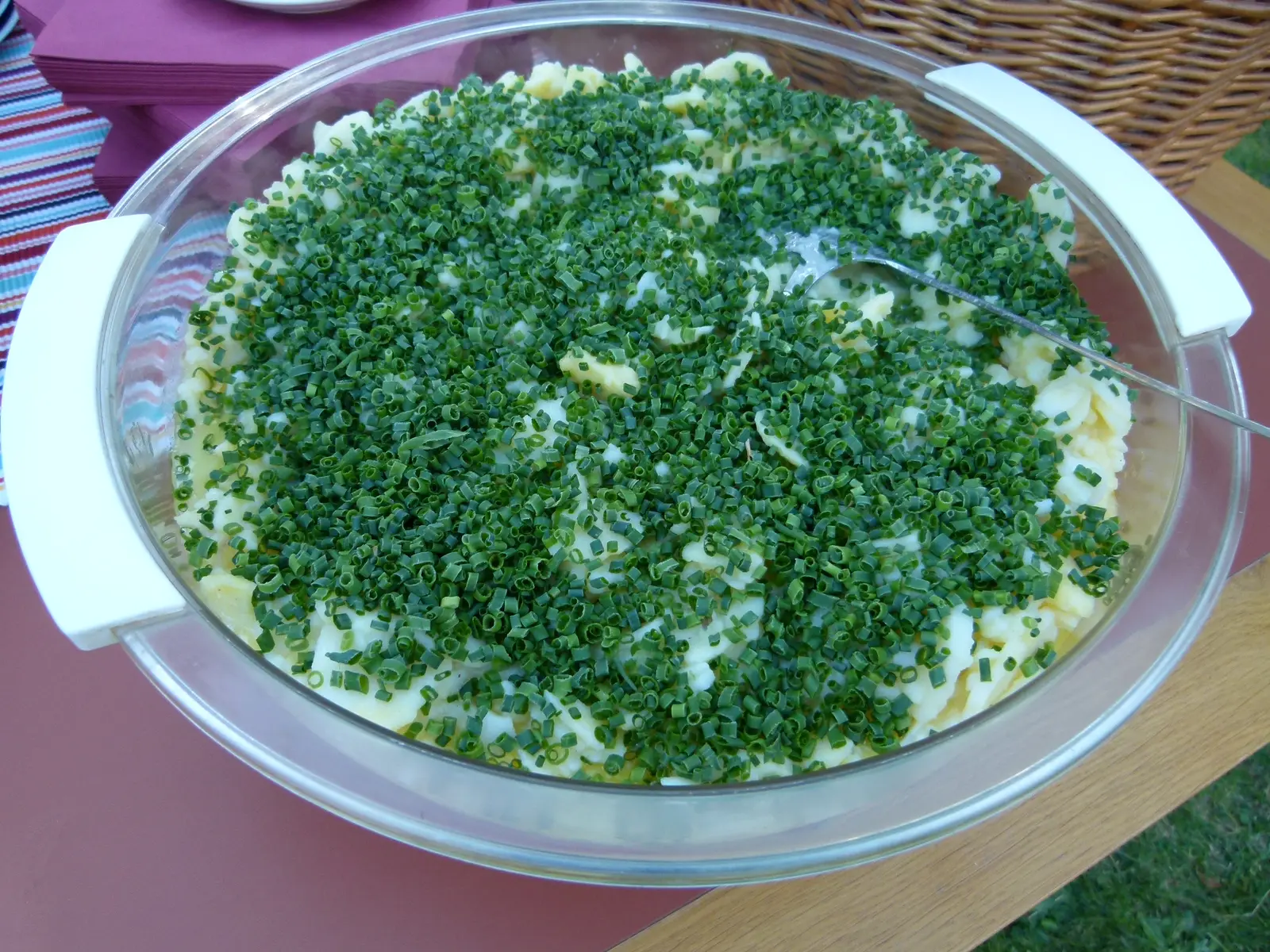
A glass bowl of warm Swabian potato salad topped with chopped chives Germany flag Germany 45m
Lunch •Swabian Heritage

German Potato Salad

This german potato salad recipe is the warm Swabian kind: waxy potatoes sliced while still hot, tossed with crisp bacon, soft onion and sliced egg, then dressed with hot beef stock, vinegar and mustard so every slice drinks up the tangy dressing. No mayonnaise anywhere — the potatoes stay light, glossy and warm. One serving is about 292 g.

Comfort & Warmth

Warm waxy potatoes in a bacon, mustard and vinegar dressing, served straight from the bowl while still steaming.

Pairs Well With
Grilled sausages, schnitzel & a cold German lager
Quick Prep (<30m)
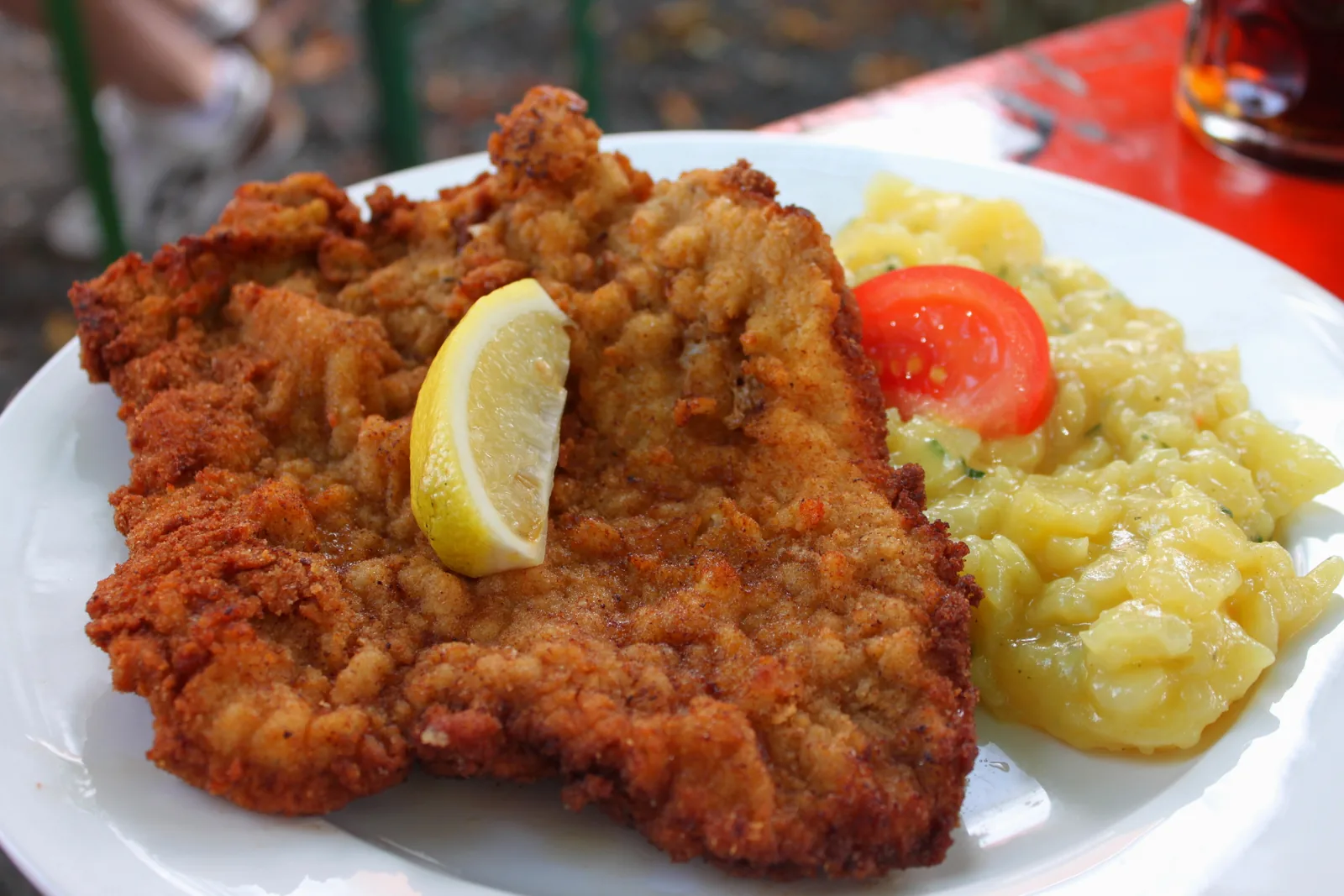
Golden breaded pork schnitzel with a lemon wedge and potato salad on a white plate Germany flag Germany 40m
Dinner •German Heritage

German Pork Schnitzel

German pork schnitzel is the everyday hero of German cooking: a pork cutlet pounded thin, coated in flour, egg and breadcrumbs, and fried in butter until it turns deep golden and crisp. This german schnitzel recipe follows the German way — real pork, a loose crumb, and a wedge of lemon on the side, with potato salad to mop up. One serving is about 200 g.

Classic Comfort

A golden, crisp pork cutlet with lemon and potato salad — a satisfying, protein-rich German dinner.

Pairs Well With
Warm potato salad, cucumber salad and a cold lager.
High Protein

The Dinner Gazette

Never wonder what’s for dinner again

One email a week with easy dinner ideas from around the world — ingredients, steps and nutrition, tested in our kitchen first.

Delivered every Thursday morning. Unsubscribe anytime.