-
1
Cook and Mash the Cassava
25 Mins
100°C (212°F)
Peel 500g of raw cassava, cut it into chunks and boil in salted water for about 20 minutes until a knife slides through easily. Drain well, pull out the woody centre string from each piece, and mash while hot until completely smooth. Weigh out 400g of the mash and let it cool until just warm.
Mash with a fork or potato masher, not a blender — a blender turns cassava into glue.
Done when: A smooth, lump-free mash with no visible fibres or hard bits.
-
2
Mix the Dough
15 Mins
Room temperature
Put the rice flour, baking powder, salt and sugar in a wide bowl and mix. Rub in the soft butter with your fingertips until the mixture looks like damp crumbs. Add the warm mashed cassava and the grated cheese, then pour in the warm milk a little at a time, mixing with your hands until a soft dough forms that holds together without sticking. Knead gently for 2 minutes only — the dough should feel like soft modelling clay.
Add the milk slowly: rice flour drinks it up unevenly, and a sticky dough makes flat, greasy rounds. Stop as soon as the dough holds together.
Done when: A soft, smooth ball that holds its shape and does not stick to your fingers.
-
3
Rest the Dough
4 Hours
Room temperature
Cover the bowl tightly with cling film or a damp cloth and leave the dough at room temperature for at least 4 hours — overnight in the fridge is even better, in which case let it come back to room temperature for 30 minutes before shaping. This long rest lets the rice flour fully hydrate, which is what makes the crumb soft instead of gritty.
Do not skip the rest: a dough baked straight away tastes sandy and cracks as it bakes.
Done when: The dough feels softer and slightly looser than when you mixed it, and a pinch of it no longer feels gritty between your fingers.
-
4
Shape the Rounds on Banana Leaves
10 Mins
Room temperature
Heat the oven to 190°C (375°F). Line a baking tray with the banana leaves, shiny side up. Wet your hands, take a large spoonful of dough (about 105g) and drop it onto the leaf, then flatten it gently with your palm into a round about 10 cm across and 1.5 cm thick. Repeat to make 12 rounds, leaving space between them. Sprinkle a little extra grated cheese over the top of each round if you like a crisp, browned cap.
Spoon-dropped rounds, not rolled balls, are the traditional shape — a slightly rough edge is exactly right.
Done when: 12 even, flat rounds on the leaves, each about the size of your palm.
-
5
Bake Until Golden
30 Mins
190°C (375°F)
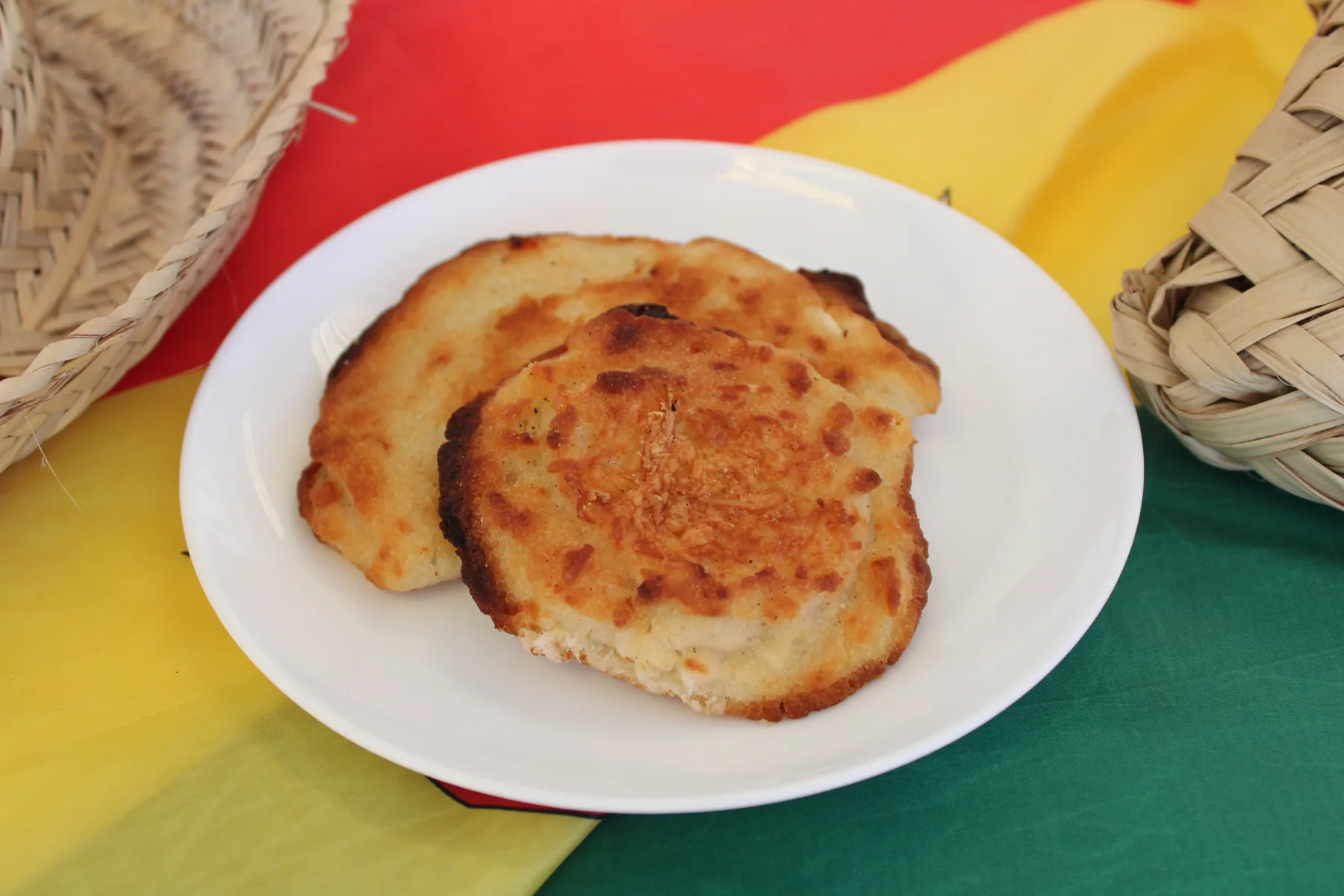
Bake in the centre of the oven for 25–30 minutes, until the rounds are puffed slightly, the edges are set and the tops are deep golden brown with crisp, browned cheese. The banana leaves will darken and smell faintly grassy — that is normal. The bread contains no egg, so judge doneness by colour and firmness, not by a skewer test alone.
If the tops are browning too fast, move the tray down one shelf; if they are pale after 25 minutes, give them 5 more minutes rather than turning the heat up.
Done when: Deep golden tops, firm edges, and a base that lifts cleanly off the leaf.
-
6
Cool Briefly and Serve Warm
5 Mins
Room temperature
Leave the rounds on the tray for 5 minutes so they firm up, then lift them off the banana leaves and serve warm. Pan de arroz is at its best within the first hour, while the cheese is still soft and the crumb is tender.
Peel the rounds off the leaves while they are still warm — once cold, they can stick.
Done when: Warm to the touch, soft inside, with a crisp golden top.
auto_awesome Finishing Touches & Plating
Serve the rounds warm, straight off the banana leaves, with coffee or hot chocolate. Any leftovers reheat well in a hot oven, but they are never quite as good as the first warm hour.

 Bolivia
2h 25m