-
1
Mix and Knead the Dough
15 Mins
Room temperature, about 20°C (68°F)
Put the 500g bread flour, the 20g sugar and the 8g salt in a large bowl and mix. Add the 280ml warm water a little at a time and stir until a shaggy dough forms. Turn it onto a lightly oiled surface and knead for about 10 minutes until smooth, elastic and soft.
Knead by pushing the dough away with the heel of your hand, folding it back and turning it. A well-kneaded dough is smooth and springs back when poked.
Done when: The dough is smooth, soft and elastic, and no longer sticks to your hands.
-
2
Rest the Dough
30 Mins
Warm place, about 25°C (77°F)
Shape the dough into a ball, brush it all over with a little of the 20ml vegetable oil, cover the bowl with cling film and leave in a warm place for 30 minutes until relaxed and soft.
Do not skip the rest — a rested dough stretches paper-thin, while a fresh dough tears and springs back.
Done when: The dough is soft, relaxed and slightly puffy, and a fingertip pressed in leaves a dent.
-
3
Stretch the Dough Paper-Thin
15 Mins
Room temperature, about 20°C (68°F)
Oil a large, clean work surface with a little of the 20ml vegetable oil. Set the dough in the middle and, with oiled hands, press and pull it outwards from the centre, lifting and stretching the edges until it is a sheet so thin you can almost see through it, about 60 cm across.
Work gently from the centre out and let the dough's own weight stretch it — pull with your fingertips, never with your nails, or it will tear. Small tears are fine; they vanish in the folding.
Done when: A wide, almost transparent sheet of dough, thin enough to see the surface through.
-
4
Brush with Ghee and Fold into Layers
10 Mins
Room temperature, about 20°C (68°F)
Brush the whole sheet generously with the melted 150g ghee, getting right to the edges. Fold the left third over the middle, then the right third over that, brush again with ghee, then fold the top third down and the bottom third up, brushing with ghee each time, until you have a small, thick square.
Be generous with the ghee — it is what keeps the layers apart in the oven. Every fold needs a full brushing.
Done when: A neat square of layered dough, glossy with ghee on every fold.
-
5
Rest, Then Stretch into a Round
20 Mins
Warm place, about 25°C (77°F)
Cover the square with cling film and rest it for 15 minutes. Then set it on a lightly oiled baking tray and, with oiled hands, press and stretch it gently into a round about 30 cm across and 2 cm thick. Brush the top with the remaining ghee.
Press gently and evenly — if the round tears, pinch it closed and carry on. A rustic, uneven round is exactly right.
Done when: A round about 30 cm across, even in thickness, glossy with ghee on top.
-
6
Bake in a Very Hot Oven
15 Mins
Very hot oven, 250°C (480°F)
Heat the oven to 250°C (480°F) with a baking tray inside. Slide the feteer onto the hot tray and bake for 12–15 minutes until deep golden and puffed, with crisp, flaky edges.
A very hot oven is essential — a cool oven dries the pastry out before it puffs. Watch it after 10 minutes; ghee browns fast.
Done when: Deep golden all over, puffed in the middle, crisp and flaky at the edges.
-
7
Cut and Serve
5 Mins
Serve warm, about 60°C (140°F)
Leave the feteer for 5 minutes, then cut it into 6 wedges and serve warm. Dust with the 20g powdered sugar if serving it sweet, and set out the 60g honey, soft cheese, olives and pickles so everyone pulls the pastry apart and dips as they like.
Feteer is pulled apart with the hands, not cut with a knife at the table — the layers separate best while it is still warm.
Done when: Warm wedges that pull apart into flaky layers, golden outside and soft inside.
auto_awesome Finishing Touches & Plating
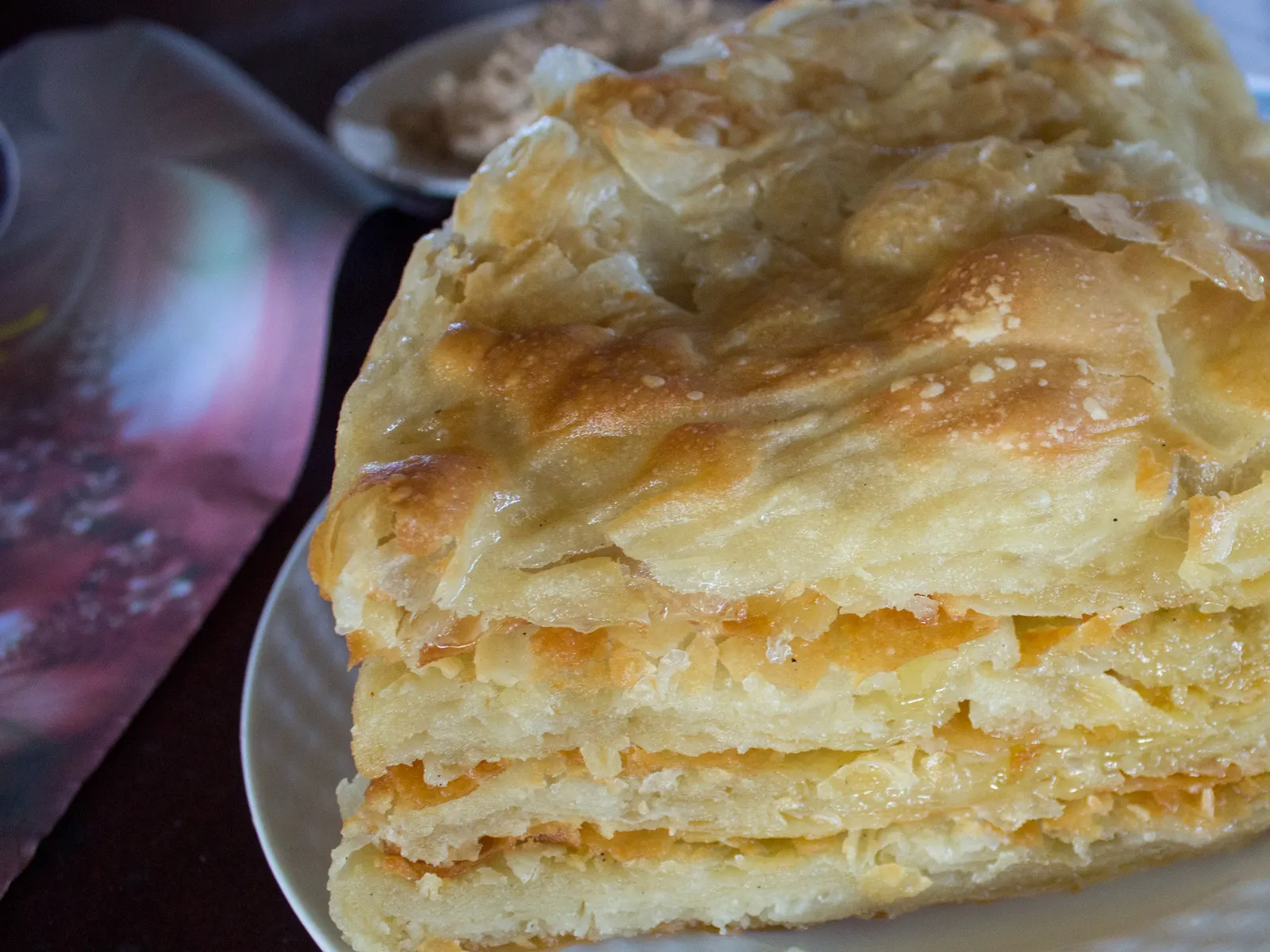
Eat feteer meshaltet while it is still warm, pulled apart with your hands so the layers separate into crisp, buttery sheets. A good feteer is deep golden and flaky outside, soft and layered inside — never pale and doughy, never burnt, and never flat like a pancake.

 Egypt
1h 15m