Curated recipes from 193 countries  •  New seasonal Mediterranean issue out now

Overview

Flan de Calabaza

Cuban Pumpkin Flan; Pumpkin Flan

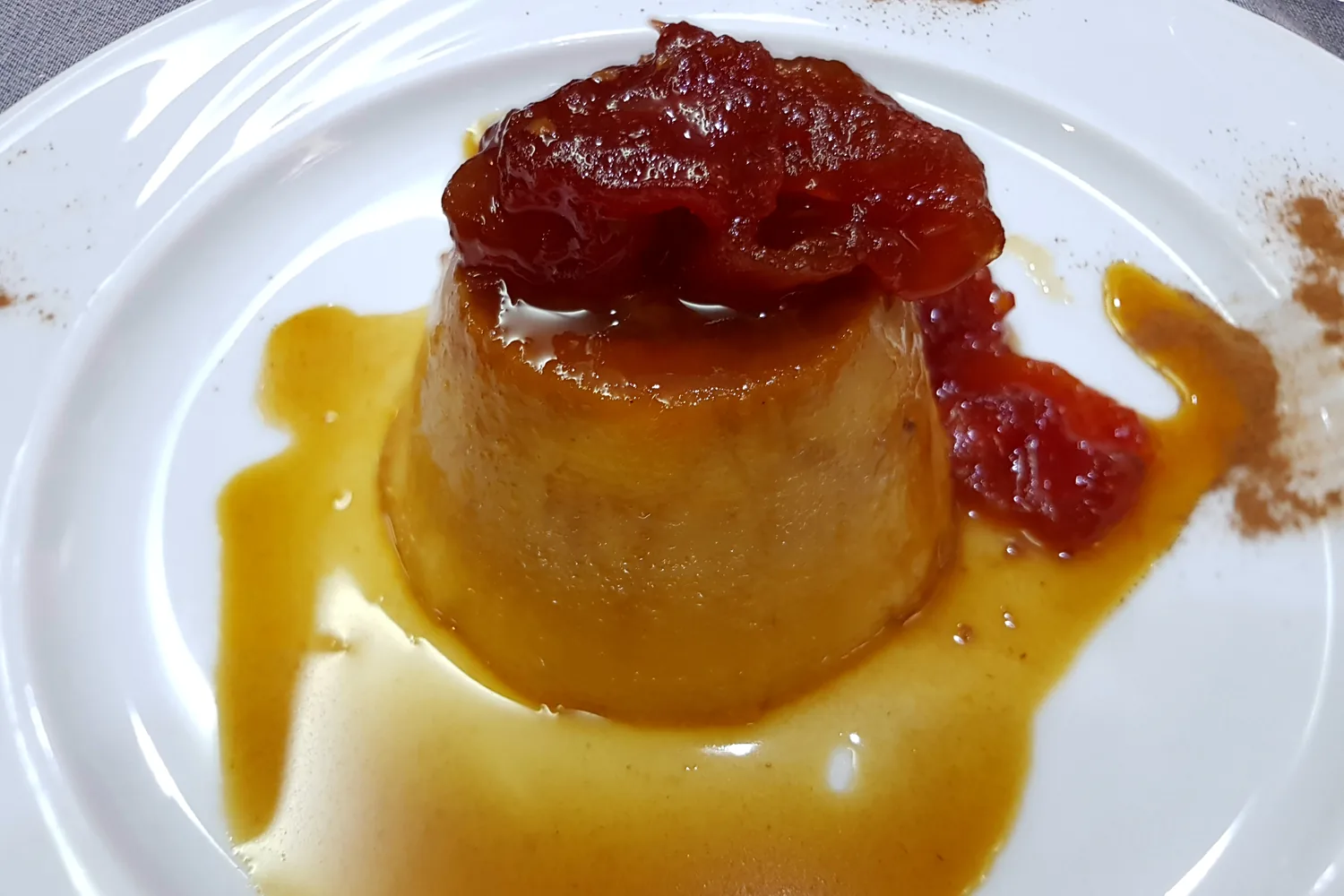
This flan de calabaza recipe is the traditional Cuban pumpkin flan: calabaza boiled with cinnamon, blended with condensed milk and whole milk, thickened with cornstarch instead of eggs, and set over amber caramel. It cooks entirely on the stovetop, chills overnight, and turns out glossy and sliceable. One serving is about 200 g. Photo note: the photo shows a pumpkin flan served at a restaurant in Valencia, Spain, used here as a visual equivalent for the same dish.

Flan reached Cuba from Spain, and Cuban cooks made it their own with calabaza, the Caribbean pumpkin that grows all over the island. The traditional Cuban version is unusual: it sets with cornstarch instead of eggs, and the whole dessert cooks on the stovetop, which mattered in homes without ovens. Today flan de calabaza is a standard dessert at Cuban family meals and celebrations, served chilled from the fridge with its caramel running down the sides.

Pairs well with: Café cubano, fresh mango and toasted pumpkin seeds

Provenance

Cuba flag Cuba

Cuba Heritage

Latin America & Caribbean

Time Dedication

1h 10m

30m prep • 40m cook

Batch Yield

8 Servings

367 kcal per serving

1 serving ≈ 200 g

Technical Skill

Intermediate

Medium (Caramel & Custard)

Meal Timing & Digestive Fit

Breakfast

Not Advised

Lunch

Inappropriate

Dinner

Inappropriate

Snack & Tea

Ideal Light Bite

Occasions: Family celebrations, Sunday lunches, holiday desserts Cost: Low — about $1–2 per serving at home
A golden pumpkin flan on a white plate, glossy with caramel and topped with a spoonful of red fruit compote

Cuba Heritage

Photo: Joanbanjo, CC BY-SA 4.0, via Wikimedia Commons

The Heritage Formulary

Measured Ingredients

Estimated cost: Low — about $1–2 per serving at home (USD)

The Cuban classic: pumpkin custard set with cornstarch under caramel, flavoured with cinnamon and vanilla.

Execution Methodology & Culinary Technique

Step-by-Step Cooking Guide

Active 1h 10m
P

Prep Stage: Peel the Pumpkin and Measure Everything

30 Mins

Peel the calabaza, scoop out the seeds and cut it into even 3 cm cubes so it boils tender at the same speed. Measure the milks, cornstarch, both sugars, vanilla and salt, and have a 23 cm round cake pan or flanera ready — the caramel sets fast once it is poured, so there is no time to hunt for the pan.

Maestro Tip: Even cubes matter more than small cubes: uneven pieces leave hard lumps in a custard that should be silk.

  1. 1

    Make the Caramel

    10 Mins Medium heat; the caramel reaches about 170°C (340°F)

    Put the caramel sugar and water in a small heavy saucepan over medium heat. Swirl the pan gently instead of stirring, and cook until the sugar melts and turns a deep amber, about 8 minutes. Pour it at once into the cake pan and tilt the pan so the caramel coats the bottom and a little way up the sides. Set it aside — it will harden as it cools.

    Do not stir the sugar while it melts: stirring makes it crystallise into grainy lumps. If it starts to colour unevenly, just swirl the pan.

    Done when: Deep amber, the colour of dark honey, with no pale or burnt-black patches.

  2. 2

    Boil the Pumpkin

    20 Mins Boiling water at 100°C (212°F)

    Put the pumpkin cubes in a large pot with the cinnamon stick and the brown sugar, cover with water and bring to a boil. Cook until the pumpkin is completely tender and crushes easily with a fork, about 20 minutes. Drain well and throw away the cinnamon stick.

    Drain the pumpkin really well — water left clinging to the cubes thins the custard and stops it setting firmly.

    Done when: A cube crushes with no resistance when pressed with a fork.

  3. 3

    Blend the Custard

    5 Mins Room temperature, about 20°C (68°F)

    Put the drained pumpkin in a blender with the condensed milk, whole milk, cornstarch, custard sugar, vanilla and salt. Blend on high until completely smooth, stopping once to scrape down the sides, about 2 minutes.

    Blend longer than you think — any fleck of pumpkin left now will show in the finished flan.

    Done when: A smooth, thick orange liquid with no flecks or lumps.

  4. 4

    Cook the Custard on the Stove

    10 Mins Medium-low heat, about 95°C (200°F)

    Pour the blended custard into a large saucepan and cook over medium-low heat, stirring constantly with a wooden spoon, until it thickens enough to coat the back of the spoon and leaves a clear trail when you draw a finger through it, about 8 minutes. Let it bubble gently for 1 minute to cook out the cornstarch taste, then take it off the heat.

    Keep stirring the whole time and scrape the corners of the pan — cornstarch settles and scorches fast if it sits still.

    Done when: Thick like pouring custard; a spoon dragged through it leaves a trail that holds for a second.

  5. 5

    Mould, Chill and Unmould

    5 Mins active, plus at least 4 hours chilling Chill in the fridge at 4°C (40°F); dip the base in hot water at about 60°C (140°F) to unmould

    Pour the hot custard over the set caramel and smooth the top. Let it cool on the counter for 30 minutes, cover, and chill in the fridge for at least 4 hours, or overnight. To serve, run a thin knife around the edge, dip the base of the pan in hot water for a few seconds, and invert it onto a cold plate so the caramel runs down the sides. Slice with a warm, dry knife.

    Do not rush the chill: a warm flan collapses when it is turned out, while a fully cold one slices cleanly.

    Done when: Firm to the touch, glossy, and holding its shape when sliced.

Finishing Touches & Plating

Chill the flan at least 4 hours, or overnight — the wait is what makes it slice cleanly. Run a thin knife around the edge, dip the base in hot water for a few seconds, and invert it onto a cold plate so the caramel runs down the sides.

Nutritional Physiology & Benefits

Nutrition

Energy

367

kcal / serving

Protein

7g

Complete AA

Carbs

73g

Complex

Fats

6g

Healthy

Per serving (8 servings · 1 serving ≈ 200 g)
Energy367 kcal
Protein7 g
Carbohydrates73 g
Fat6 g
Fibre0.5 g
Sugar62.4 g
Sodium189 mg
Per 100g
Energy183 kcal
Protein3.4 g
Carbohydrates36.2 g
Fat3.2 g
Fibre0.2 g
Sugar31.2 g
Sodium94 mg

Nutrition values are estimated — calculated from USDA FoodData Central values for the listed ingredients.

Vitamins & minerals: A serving provides vitamin A from the pumpkin, plus calcium from the milk and condensed milk, with small amounts of vitamin C, potassium and iron.

Vitamin A from Pumpkin

A serving carries a generous amount of beta-carotene from the calabaza, which the body turns into vitamin A, plus vitamin C and potassium.

Calcium from Milk

Whole milk and condensed milk give each serving calcium for bones and teeth, in a dessert that needs no oven and no eggs.

Naturally Gluten-Free

There is no flour in this flan at all — pumpkin, milk, cornstarch and sugar — so it is gluten-free as written.

Food Pairings

What to Eat With

To optimize nutrient absorption and elevate the sensory depth, pair with these authentic accompaniments:

Drinks

Café Cubano

A small, strong, sweet Cuban coffee is the classic partner — its bitterness cuts the flan's richness and wakes up the cinnamon.

Sides

Fresh Mango Slices

Cool, tart mango next to the flan gives the plate acidity and freshness, so the caramel does not feel too sweet.

Full Menus

After Ropa Vieja

A chilled slice is the natural finish to a rich Cuban main like ropa vieja with rice — cool, sweet and light after a savoury stew.

More Pairings

Toasted Pumpkin Seeds

A spoonful of toasted, lightly salted pumpkin seeds on top adds crunch and echoes the pumpkin inside the flan.

Complete menu

Serve ropa vieja with white rice and black beans, then finish with a chilled slice of flan de calabaza and a small café cubano.

Digestive Guardrails

What NOT to Combine

To prevent digestive distress, sluggishness, or palate clash, avoid pairing the dish with these elements:

Unmoulding While Warm

A warm flan has not set and will slump into a puddle when turned out. Chill it fully — at least 4 hours — before unmoulding. This is general information, not medical advice.

Very Sweet Drinks

With about 62 g of sugar a serving, the flan is already very sweet — a sugary soda or sweet liqueur alongside it doubles the sugar load. Plain coffee or water suits it better. This is general information, not medical advice.

General information only, not medical advice — consult a doctor for personal dietary decisions.

Who Should Eat It

Who Should Eat

  • General adultsA rich dessert for most adults at about 367 kcal a serving — one slice after a meal is plenty.
  • ChildrenChildren usually love it: sweet, smooth and mild. Serve a small slice, chilled, and keep it as an occasional dessert rather than an everyday one.
  • ElderlySoft, smooth and easy to swallow, with no chewing needed; serve chilled and keep the slice small if sugar is a concern.
  • Pregnant womenGenerally suitable: everything is fully cooked and the milk is pasteurised. Keep it to one small slice because of the sugar.
  • Breastfeeding womenA sweet, energy-rich dessert with calcium from the milk; enjoy a slice after a meal rather than on an empty stomach.
  • AthletesA quick source of energy after training at about 73 g of carbohydrate a serving, but low in protein — pair it with a protein-rich meal, not as a meal on its own.
  • Weight gainAn easy way to add calories: a full slice with cream or a second helping adds up fast.
  • Weight lossBest as a small, occasional treat — about 367 kcal and 62 g of sugar a serving is a lot for a dessert, so keep the slice thin.

Health Conditions — Adjust or Avoid

Conditions

  • DiabetesAbout 73 g of carbohydrate and 62 g of sugar per serving — a large amount for one dessert, so keep the slice small and count it in your meal plan. Ask your clinician about portion size.
  • High blood pressureAbout 189 mg of sodium per serving as written, which is low for a dessert; the sugar is the bigger concern here. Ask your clinician about portion size.
  • Kidney diseasePumpkin and milk both add potassium, so keep the portion small if you limit potassium. Ask your clinician about portion size.
  • GoutLow in purines as written, with no meat or seafood in the flan itself. Ask your clinician about portion size.
  • Stomach issuesMild, cool and smooth, so it usually sits well; the richness and sweetness can feel heavy on a sensitive stomach, so eat a small slice slowly. Ask your clinician about portion size.
  • Cardiovascular diseaseCondensed milk and whole milk add saturated fat, and the sugar load is high — treat it as an occasional dessert in a small portion. Ask your clinician about portion size.
  • Fatty liverHigh in sugar, which the liver turns into fat, so keep it occasional and the slice small. Ask your clinician about portion size.
  • Food allergiesContains milk (dairy). It has no eggs and no flour as written, so it suits egg allergy and is gluten-free — but check your cornstarch label if you are coeliac. Ask your clinician about portion size.
  • Special therapeutic dietsHard to adapt without changing the dish — the condensed milk and sugar are what make it a flan. A smaller slice is the simplest adjustment. Ask your clinician about portion size.

If you have a medical condition, consult your doctor before changing your diet.

Storage & Use

Storage & Use

How to store
Cool completely, cover tightly and store in the fridge.
In the fridge
Up to 4 days in the fridge at 4°C (40°F) or below, covered.
In the freezer
Not recommended — freezing makes the cornstarch custard weep and the caramel thin out on thawing.
How to reheat
Serve chilled; do not reheat — heat melts the set custard and the caramel runs off.
Freezing recommended
No — the cornstarch custard turns watery and the caramel thins after thawing.
Signs it has spoiled
Sour smell, mould, or a watery, separated texture — discard it.

More recipes to explore

A plate of ropa vieja, shredded beef in tomato sauce, with yellow rice, black beans and fried plantains Cuba flag Cuba 3h
Dinner •Cuba's National Dish

Ropa Vieja

This ropa vieja recipe braises flank steak low and slow until it falls into long shreds, then simmers it in a tomato, pepper and olive sauce. One serving is about 310 g. Serve it over white rice with black beans and fried plantains, the way Cuban families do.

Comfort & Warmth

Slow-braised shredded beef in a tomato and pepper sauce, served with rice and black beans.

Pairs Well With
White rice, black beans and fried plantains
High Protein
A pressed Cuban sandwich cut in half, with melted Swiss cheese and layers of ham and pork, served with pickle spears Cuba flag Cuba 25m
Lunch •Havana Classic

Cuban Sandwich

This cuban sandwich recipe layers mojo roast pork, ham, Swiss cheese, pickles and mustard on Cuban bread, then presses it flat until the crust crackles and the cheese melts. One serving is about 345 g. It is a great use for leftover roast pork and comes together in 25 minutes.

Comfort & Warmth

A pressed sandwich of roast pork, ham, Swiss cheese, pickles and mustard on Cuban bread.

Pairs Well With
Plantain chips and a cold lager or lime soda
A plate of dark moros y cristianos rice cooked with black beans, served with slices of roast pork and golden fried plantains Cuba flag Cuba 1h 30m
Lunch •Cuban Heritage

Moros y Cristianos

This moros y cristianos recipe cooks Cuban black beans and rice together in one pot: dried black beans simmered until tender, then long-grain rice cooked in the dark bean liquid with a sofrito of onion, green pepper and garlic, cumin, oregano and bay leaf. The grains come out dark, fragrant and fluffy, never pale or plain. One serving is about 272 g.

Comfort & Warmth

Cuban black beans and white rice cooked together in one pot with sofrito, cumin, oregano and bay leaf, until the grains turn dark.

Pairs Well With
Roast pork or ropa vieja with fried sweet plantains and a crisp cabbage salad, the classic Cuban plate.
A plate of Cuban lechon asado with shredded mojo pork, onions and lime, yellow rice with black beans and fried plantains Cuba flag Cuba 5h 30m
Dinner •Havana Heritage

Cuban Lechon Asado

This cuban lechon asado recipe marinates a pork shoulder overnight in mojo — sour orange juice, a whole head of garlic, oregano and cumin — then roasts it low and slow until the meat is so tender it pulls apart with a fork. It is the centrepiece of Nochebuena, the Cuban Christmas Eve feast, and it is nothing like Filipino lechon: there is no whole crispy-skinned pig here, just a mojo-soaked shoulder roast. One serving is about 250 g.

Celebration & Sharing

A whole pork shoulder marinated overnight in sour-orange mojo, then roasted low and slow until it pulls apart — the centrepiece of Nochebuena.

Pairs Well With
Shredded mojo pork with black beans, yellow rice and fried plantains
High Protein

The Dinner Gazette

Never wonder what’s for dinner again

One email a week with easy dinner ideas from around the world — ingredients, steps and nutrition, tested in our kitchen first.

Delivered every Thursday morning. Unsubscribe anytime.