Curated recipes from 193 countries  •  New seasonal Mediterranean issue out now

Overview

Moroccan Snail Soup

Babbouche, Bebouch, Ghlal, Lebloul

This moroccan snail soup recipe is babbouche from the Jemaa el-Fnaa in Marrakech: garden snails simmered for an hour and a half in a fragrant broth of thyme, aniseed, caraway, mint, licorice and chili, then served in small bowls with the hot, peppery broth to sip. One serving is about 450 g.

Babbouche is the famous snail soup of the Jemaa el-Fnaa, the great square of Marrakech, where a line of sturdy carts sells it by the broth-filled bowl as the evening market starts to hum. The snails are simmered in a broth spiced with more than fifteen ingredients — thyme, aniseed, licorice, mint, tea leaves and chili among them — and the hot broth is sipped at the end, said by locals to be warming and restorative. Paula Wolfert's The Food of Morocco (2012) records the dish and its spice blend from a Marrakech spice seller.

Pairs well with: Mint tea, crusty bread & lemon wedges

Provenance

Morocco flag Morocco

Marrakech Street-Food Classic

Middle Eastern

Time Dedication

2h

30m prep • 90m cook

Batch Yield

6 Servings

60 kcal per serving

1 serving ≈ 450 g

Technical Skill

Intermediate

Medium (One Pot)

Meal Timing & Digestive Fit

Breakfast

Not Advised

Lunch

Inappropriate

Dinner

Inappropriate

Snack & Tea

Ideal Light Bite

Soups & Broths Occasions: Winter evenings, street-food nights, adventurous tastings, cold-weather comfort Cost: Low — about $2 per serving at home
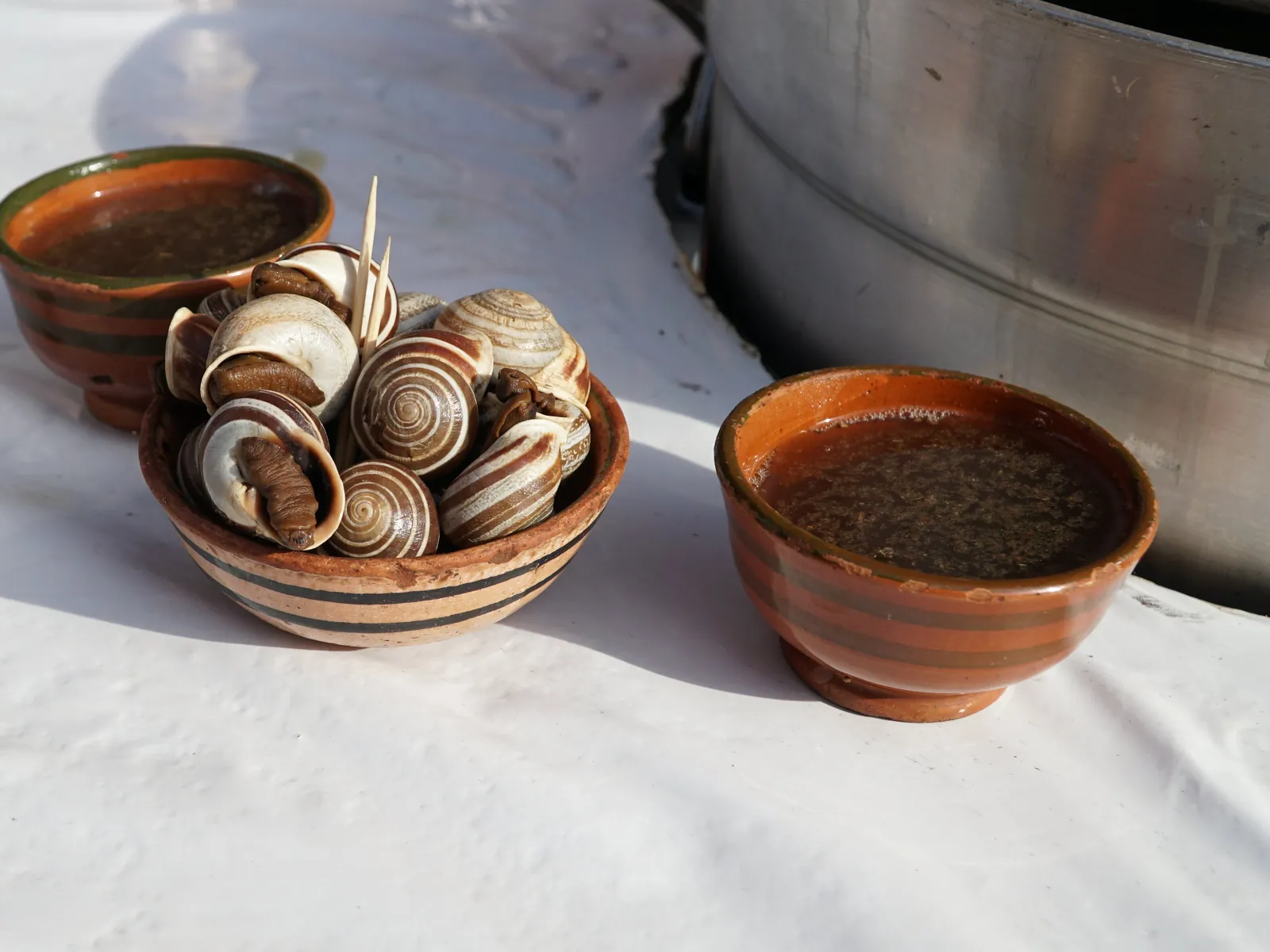
A clay bowl of Moroccan snail soup with striped snails and toothpicks, beside two small bowls of dark spiced broth at a Marrakech street stall

Marrakech Street-Food Classic

Photo: Adam Harangozó, CC BY-SA 4.0, via Wikimedia Commons

The Heritage Formulary

Measured Ingredients

Estimated cost: Low — about $2 per serving at home (USD)

A home version of the Marrakech street-stall classic: snails in a dark, peppery, herbal broth.

Execution Methodology & Culinary Technique

Step-by-Step Cooking Guide

Active 2h
P

Purge the Snails & Tie the Spice Bundle

30 Mins • One Pot

Scrub the snails under cold running water with salt, rinse again and again until the water runs clear and no slime remains. Tie the thyme, aniseed, caraway, tea, licorice, bay, dried mint, chili, orange peel and gum arabic into a square of muslin so the spices flavour the broth without floating loose in it.

Maestro Tip: Buy the snails from a trusted food seller and never use wild snails that have not been properly purged — they must be cleaned thoroughly before cooking.

  1. 1

    Purge and Scrub the Snails

    15 Mins Cold water

    Put the snails in a large bowl, sprinkle with a handful of salt and scrub them under cold running water, rubbing the shells together. Drain, rinse and repeat until the water runs completely clear and the shells feel clean, with no slime left.

    If the water is still cloudy after three rinses, keep rinsing — clean snails make a clear, sweet broth.

    Done when: The rinse water runs clear and the shells are clean to the touch.

  2. 2

    Rinse Until Clear

    10 Mins Cold water

    Give the snails one final rinse in a big bowl of cold water, lift them out with your hands so any grit stays at the bottom, and set them in a colander to drain.

    Lifting the snails out instead of pouring leaves the grit behind in the bowl.

    Done when: The snails are clean, drained and ready for the pot.

  3. 3

    Build the Spice Bundle and Broth

    10 Mins Room temperature, about 22°C (72°F)

    Tie the thyme, aniseed, caraway, tea leaves, licorice root, bay leaves, dried mint, chili, orange peel and gum arabic into a muslin square. Put the snails in a large pot, cover with 2 litres of cold water, add the bundle and the salt, and bring to the boil over high heat.

    Tying the spices in muslin keeps the broth clear and means nobody bites into a whole chili.

    Done when: The water is at a rolling boil and the spice bundle is fully submerged.

  4. 4

    Simmer Low and Slow

    90 Mins Gentle simmer, about 95°C (200°F)

    Reduce the heat to a gentle simmer, cover loosely and cook for 1 hour and 30 minutes, until the snails are tender and the broth is dark, fragrant and peppery. Skim any foam from the surface in the first 15 minutes. Stir in the fresh mint leaves for the last 10 minutes.

    Keep the simmer gentle — hard boiling makes the snail meat tough.

    Done when: The snails pull easily from their shells and the broth tastes herbal, peppery and warm.

  5. 5

    Serve with Broth and Toothpicks

    5 Mins Serving temperature, about 70°C (160°F)

    Lift out the spice bundle and discard it. Ladle the snails into small bowls with plenty of the hot broth, and hand out toothpicks for pulling the meat from the shells. Drink the broth from the bowl when the snails are finished.

    Serve the broth in small cups alongside, as the Marrakech stalls do — the broth is half the dish.

    Done when: Each bowl holds hot snails in dark, fragrant broth, ready to eat with a toothpick.

Finishing Touches & Plating

Serve the moroccan snail soup piping hot from the pot, snails and broth together, with mint tea and crusty bread to mop up the last of the broth.

Nutritional Physiology & Benefits

Nutrition

Energy

60

kcal / serving

Protein

9g

Complete AA

Carbs

4g

Complex

Fats

1g

Healthy

Per serving (6 servings · 1 serving ≈ 450 g)
Energy60 kcal
Protein9 g
Carbohydrates4 g
Fat1 g
Fibre1.6 g
Sugar0.0 g
Sodium426 mg
Per 100g
Energy13 kcal
Protein1.9 g
Carbohydrates0.9 g
Fat0.2 g
Fibre0.4 g
Sugar0 g
Sodium95 mg

Nutrition values are estimated — calculated from USDA FoodData Central values for the listed ingredients.

Vitamins & minerals: Iron and magnesium (snails), vitamin C (mint), calcium (snails, herbs).

Lean Protein

About 8.7 g of protein per serving from the snail meat, with only about 1.0 g of fat.

Warming Herbs

Thyme, mint, aniseed and licorice make a fragrant broth that feels warming on a cold evening.

Light and Satisfying

About 60 kcal per serving means the soup is light, while the warm broth and protein keep you satisfied.

Food Pairings

What to Eat With

To optimize nutrient absorption and elevate the sensory depth, pair with these authentic accompaniments:

Drinks

Mint Tea

Sweet Moroccan mint tea is the classic companion — its cool mint echoes the herbs in the broth and cleanses the palate.

Sparkling Water

Cold sparkling water with lemon refreshes the palate between spoonfuls of the hot, spiced broth.

Sides

Crusty Bread

A piece of crusty bread is for mopping up the last of the spiced broth, which is too good to leave in the bowl.

Vegetables

Lemon Wedges

A squeeze of lemon brightens the dark, peppery broth and lifts the mild flavour of the snail meat.

Complete menu

Moroccan snail soup with mint tea, crusty bread and lemon wedges.

Digestive Guardrails

What NOT to Combine

To prevent digestive distress, sluggishness, or palate clash, avoid pairing the dish with these elements:

Eating Snails That Were Not Purged and Cooked Through

Snails must be purged, scrubbed and simmered for the full 90 minutes — undercooked or unclean snails can carry harmful bacteria and parasites. Buy from a trusted seller and cook thoroughly. This is general food-safety information, not medical advice.

Drinking Large Amounts of the Salty Broth

The broth is seasoned and salty, about 426 mg of sodium per serving; enjoy a bowl or two rather than drinking pot after pot. This is general nutrition information, not medical advice.

General information only, not medical advice — consult a doctor for personal dietary decisions.

Who Should Eat It

Who Should Eat

  • General adultsA light, warming snack for adults who enjoy adventurous street food; one bowl is a reasonable portion.
  • ChildrenChildren in Morocco often eat babbouche, but the snails and hot, spiced broth suit older children better; serve a small bowl and help with the toothpick.
  • ElderlySoft snail meat is easy to chew, but the broth is salty and spiced; a small bowl suits most older adults.
  • Pregnant womenThe snails must be thoroughly cooked and the broth is salty and spiced; eat only a small bowl and ask your clinician first.
  • Breastfeeding womenThe broth is salty and strongly spiced; keep to a small bowl and ask your clinician before eating.
  • AthletesA light, protein-rich snack after training; pair it with bread and tea for more energy.
  • Weight gainAbout 60 kcal per bowl makes it a very light snack; add bread and tea if you need more energy.
  • Weight lossBest kept to an occasional small bowl; the broth is salty, so ask your clinician about fitting it into your plan.

Health Conditions — Adjust or Avoid

Conditions

  • DiabetesAbout 4.0 g of carbohydrate per serving is low; the salt is the main concern, so keep to one bowl and ask your clinician about portion size.
  • High blood pressureAbout 426 mg of sodium per serving is high; keep to one small bowl and ask your clinician if you follow a low-sodium plan.
  • Kidney diseaseThe soup is low in protein and high in sodium, so it fits only as an occasional small bowl; ask your clinician about portion size.
  • GoutSnails are low in purines, but the salty broth adds sodium; enjoy rarely and ask your clinician if unsure.
  • Stomach issuesThe peppery, spiced broth can irritate a sensitive stomach; eat a small bowl slowly and ask your clinician if symptoms flare.
  • Cardiovascular diseaseAbout 1.0 g of fat per serving is very low; the sodium is the main concern, so keep to one bowl and ask your clinician about your overall salt intake.
  • Fatty liverThe soup is very light and low in fat; the salt adds up quickly, so keep to one bowl and ask your clinician about how often it fits your plan.
  • Food allergiesContains molluscs (snails). Do not serve to anyone with a mollusc or shellfish allergy; ask your clinician if you are unsure.
  • Special therapeutic dietsNot suitable as a regular food for therapeutic diets that limit salt; ask your clinician before including it.

If you have a medical condition, consult your doctor before changing your diet.

Storage & Use

Storage & Use

How to store
Cool quickly, then keep the snails in their broth in a covered pot.
In the fridge
Up to 2 days in the fridge in the broth; reheat to a rolling boil before serving.
In the freezer
Do not freeze — the snails turn rubbery and the broth loses its fragrance.
How to reheat
Bring the snails and broth back to a rolling boil and simmer for 5 minutes, until steaming hot throughout.
Freezing recommended
No — the texture of the snails suffers badly on freezing.
Signs it has spoiled
Sour smell, slimy broth or snails that smell off mean the soup should be thrown away.

More recipes to explore

Moroccan lamb and prune tagine with almonds and sesame Morocco flag Morocco 2h 35m
Lunch •Atlas Mountains

Lamb & Prune Tagine

Clay vessel braised lamb shoulder infused with Ras el Hanout, saffron stamens, and natural sun-dried fruit pectins.

Immunity & Warming

Slow-braised lamb with prunes, almonds and couscous.

Pairs Well With
Spiced Couscous & Preserved Lemon Salad
High Protein
A clay bowl of Moroccan couscous with vegetables, chickpeas, carrot and pumpkin Morocco flag Morocco 1h 15m
Dinner •Maghreb Friday Table

Moroccan Couscous with Vegetables

This moroccan couscous recipe steams fine semolina until fluffy, then ladles over a slow-cooked stew of seven vegetables, chickpeas and warm spices. One serving is about 475 g.

Comfort & Warmth

Fluffy steamed semolina with a slow vegetable stew and chickpeas.

Pairs Well With
Harissa, mint tea and crusty bread
Quick Prep (<30m)
A bowl of Moroccan harira soup with chickpeas, noodles and fresh herbs Morocco flag Morocco 1h 15m
Lunch •Ramadan Iftar Table

Harira Soup

This harira soup recipe simmers lentils, chickpeas, tomatoes and lamb with ginger, cinnamon and fresh herbs, then thickens it the traditional way with a flour slurry. One serving is about 450 g.

Comfort & Warmth

A thick, warming tomato and lentil soup, the soup Moroccans break their fast with.

Pairs Well With
Dates, chebakia and mint tea
Soups & Broths • High Protein
Moroccan chicken tagine with preserved lemon slices, green olives and fresh parsley Morocco flag Morocco 1h 15m
Dinner •Moroccan Heritage

Moroccan Chicken Tagine

Moroccan chicken tagine is the dish Morocco is best known for: chicken braised slowly with onions, ginger and saffron, then finished with salty preserved lemon and green olives. This moroccan chicken tagine recipe uses a heavy pot instead of a clay tagine, so anyone can make it — the conical lid's job is done by a tight-fitting lid and a gentle flame. One serving is about 315 g.

Slow-Cooked Comfort

Chicken braised slowly with ginger, saffron, preserved lemon and green olives until the meat falls from the bone.

Pairs Well With
Couscous, khobz bread and mint tea.
High Protein

The Dinner Gazette

Never wonder what’s for dinner again

One email a week with easy dinner ideas from around the world — ingredients, steps and nutrition, tested in our kitchen first.

Delivered every Thursday morning. Unsubscribe anytime.