Curated recipes from 193 countries  •  New seasonal Mediterranean issue out now

Overview

Sopa de Quinua

Bolivian Quinoa Soup, Andean Quinoa Soup, Quinua Soup

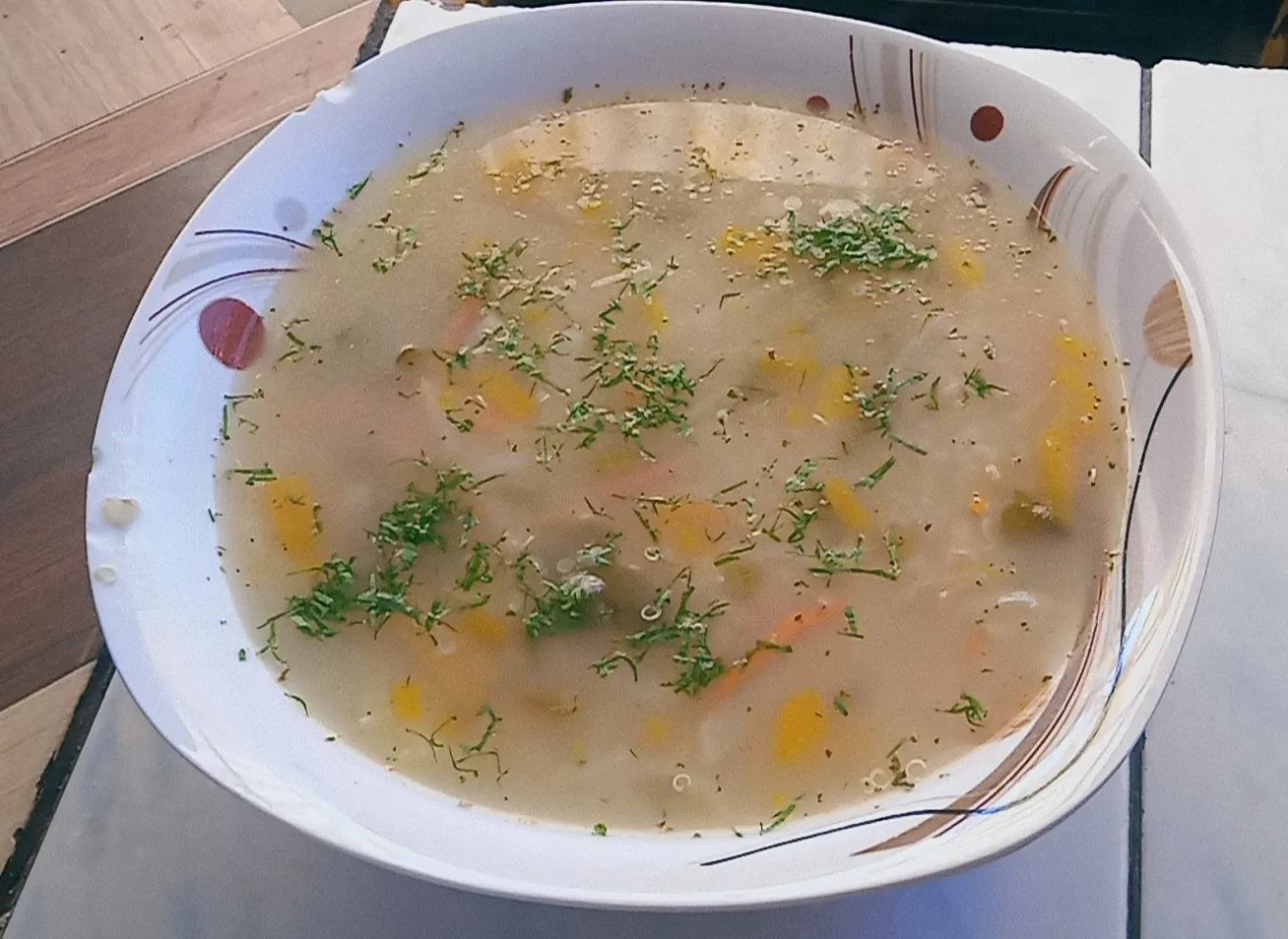
This sopa de quinua recipe is Bolivia's everyday quinoa soup: quinoa simmered in a light vegetable broth with potato, carrot, peas and celery, seasoned with cumin and oregano and finished with fresh coriander. One serving is about 510 g. It is a clear, brothy soup — no milk, no cheese, no egg — the way Bolivian home cooks make it for lunch, with the quinoa itself doing the work of making the bowl filling.

Quinoa was first grown in the high Andes around Lake Titicaca, on the border of modern Bolivia and Peru, where it has been a staple grain for thousands of years — the Incas called it the mother of all grains. In Bolivia, the country that grows some of the world's finest quinoa, the grain goes into a simple home soup with potato, carrot, peas and celery, cooked in broth and seasoned with cumin and oregano. It is not the creamy Peruvian chupe, which finishes its quinoa soup with milk, cheese and beaten egg; the Bolivian sopa de quinua stays a clear, brothy soup, and the quinoa itself — soft grains that open into little spirals — is what makes the bowl filling. It is everyday lunch food in the highlands, served steaming hot with bread.

Pairs well with: Serve with crusty bread and a wedge of lime on the side, and a simple green salad if you want a fuller lunch.

Provenance

Bolivia flag Bolivia

Andean Home-Cooking Classic

Latin America & Caribbean

Time Dedication

55m

20m prep • 35m cook

Batch Yield

4 Servings

342 kcal per serving

1 serving ≈ 510 g

Technical Skill

Easy

Easy (One Pot)

Meal Timing & Digestive Fit

Breakfast

Not Advised

Lunch

Prime Metabolic Fit

Dinner

Ideal Hearty Main

Snack & Tea

Inappropriate

Soups & Broths Occasions: Family lunch, weekday lunch, light dinner, cold-day soup Cost: Low — about $2–3 per serving at home
A white bowl of pale quinoa soup with pieces of carrot and chopped fresh herbs scattered on top

Andean Home-Cooking Classic

Photo: Trujillo Wendy, CC BY-SA 4.0, via Wikimedia Commons

The Heritage Formulary

Measured Ingredients

Estimated cost: Low — about $2–3 per serving at home (USD)

Made the Bolivian home way: quinoa rinsed well, simmered in a clear vegetable broth with potato, carrot and peas, finished with fresh coriander.

Execution Methodology & Culinary Technique

Step-by-Step Cooking Guide

Active 55m
P

Prep Stage: Rinse the Quinoa & Chop the Vegetables

20 Mins • Rinsing & Chopping

Rinse the quinoa in a fine sieve under cold running water until the water runs clear — this washes off the bitter coating called saponin. Peel and dice the potatoes and carrots, chop the onion, celery and garlic, and measure out the stock, peas and spices so the soup goes together in one smooth sequence.

Maestro Tip: Do not skip the rinse: unrinsed quinoa tastes bitter and soapy no matter how long you cook it.

  1. 1

    Soften the Onion, Celery and Garlic

    6 Mins Medium heat, ~175°C (350°F)

    Heat the olive oil in a large pot over medium heat. Add the onion and celery and cook for 5 minutes until soft and translucent, then stir in the garlic and the ground cumin and cook for 1 minute more, until fragrant.

    Keep the heat at medium — browned onion makes the broth cloudy and bitter.

    Done when: The onion is soft and see-through and the pot smells of garlic and cumin.

  2. 2

    Add the Quinoa, Potato and Carrot

    5 Mins High heat, ~200°C (400°F) to bring to a boil

    Stir in the rinsed quinoa, the diced potato and carrot, and the dried oregano. Pour in the 1200 ml of vegetable stock and add half the salt. Bring to a boil over high heat, skimming off any foam that rises.

    Skim the foam in the first minutes — it is mostly saponin and starch, and removing it keeps the broth clear.

    Done when: The pot is at a rolling boil with a clear surface and the vegetables are covered by stock.

  3. 3

    Simmer Until the Quinoa Opens

    20 Mins Gentle simmer, ~95°C (200°F)

    Lower the heat to a gentle simmer, cover with the lid ajar and cook for 20 minutes, until the quinoa grains have opened into little spirals and the potato is tender all the way through.

    The lid ajar lets a little steam out so the soup stays brothy instead of turning into porridge.

    Done when: The quinoa shows its white spiral tails and a potato cube crushes easily against the side of the pot.

  4. 4

    Stir in the Peas

    5 Mins Gentle simmer, ~95°C (200°F)

    Stir in the frozen peas and simmer for 5 more minutes, until the peas are bright green and tender and the soup has thickened just slightly.

    Add the peas last — they need only minutes, and long cooking turns them grey and mealy.

    Done when: The peas are bright green, the quinoa is soft, and the broth is lightly thickened.

  5. 5

    Season and Finish with Coriander

    2 Mins Off the heat

    Take the pot off the heat. Taste and add the remaining salt if needed, then stir in the chopped coriander. Cover and let the soup stand for 2 minutes so the herbs soften into the broth, then ladle into deep bowls and serve hot.

    Taste before adding the last salt — the stock already carries salt, and the soup should taste clean, not salty.

    Done when: A clear, fragrant broth with quinoa, potato, carrot and green peas in every spoonful.

Finishing Touches & Plating

Ladle the sopa de quinua into deep bowls while it is still steaming, with a little extra chopped coriander on top and crusty bread on the table — and a squeeze of lime if you like the broth brighter.

Nutritional Physiology & Benefits

Nutrition

Energy

342

kcal / serving

Protein

12g

Complete AA

Carbs

59g

Complex

Fats

7g

Healthy

Per serving (4 servings · 1 serving ≈ 510 g)
Energy342 kcal
Protein12 g
Carbohydrates59 g
Fat7 g
Fibre8.9 g
Sugar8.3 g
Sodium894 mg
Per 100g
Energy67 kcal
Protein2.3 g
Carbohydrates11.6 g
Fat1.3 g
Fibre1.7 g
Sugar1.6 g
Sodium175 mg

Nutrition values are estimated — calculated from USDA FoodData Central values for the listed ingredients.

Vitamins & minerals: Provides vitamin A from the carrots, vitamin C from the peas and coriander, folate from the quinoa, and potassium from the potatoes.

Quinoa, a Complete Protein

Quinoa is one of the few plant foods that contains all nine essential amino acids, and one serving gives about 11.6 g of protein.

High in Fibre, Light in Fat

One serving carries about 8.9 g of fibre from the quinoa, potato, carrot and peas, with only about 6.8 g of fat.

Vitamin A and Vitamin C

The carrots supply vitamin A and the peas and coriander supply vitamin C, in a broth that is naturally low in fat.

Food Pairings

What to Eat With

To optimize nutrient absorption and elevate the sensory depth, pair with these authentic accompaniments:

Sides

Crusty Bread

Crusty bread is the natural partner: it soaks up the light broth and turns a bowl of soup into a proper lunch.

Vegetables

Simple Green Salad

A green salad with a lime dressing adds crunch and acidity against the soft, warm soup.

Drinks

Herbal Tea

A warm herbal tea, such as chamomile, suits the gentle, clean flavours of the soup.

More Pairings

A Wedge of Lime

A squeeze of lime at the table brightens the broth and lifts the cumin without changing the soup itself.

Complete menu

Serve the sopa de quinua with crusty bread and a simple green salad, and finish with fresh fruit for a complete Bolivian lunch.

Digestive Guardrails

What NOT to Combine

To prevent digestive distress, sluggishness, or palate clash, avoid pairing the dish with these elements:

Do Not Skip Rinsing the Quinoa

Unrinsed quinoa carries a bitter coating called saponin that no amount of cooking removes. Rinse until the water runs clear. This is general cooking guidance, not medical advice.

Do Not Leave the Soup Out for Hours

Cooked soup should not sit out for more than 2 hours. Cool leftovers quickly and reheat them properly. This is general food-safety guidance, not medical advice.

General information only, not medical advice — consult a doctor for personal dietary decisions.

Who Should Eat It

Who Should Eat

  • General adultsA light, filling lunch — about 342 kcal and 11.6 g of protein per serving.
  • ChildrenChildren usually like it; the quinoa is soft and the vegetables are mild — serve a small bowl with bread.
  • ElderlySuitable in a moderate portion; the soup is soft, warm and easy to eat, but the salt is worth watching.
  • Pregnant womenGenerally suitable — the quinoa, vegetables and vegetable stock are all plain foods. Ask your clinician about portions.
  • Breastfeeding womenGenerally suitable; the quinoa and vegetables make it a balanced, gentle lunch.
  • AthletesA good light training-day lunch for carbohydrate and fibre, with about 59.1 g of carbohydrate per serving — add bread for more energy.
  • Weight gainA light choice on its own — add a second bowl or bread with olive oil to add energy.
  • Weight lossA strong choice — a full bowl is only about 342 kcal and the fibre keeps you full. Ask your clinician about portions.

Health Conditions — Adjust or Avoid

Conditions

  • DiabetesOne serving carries about 59.1 g of carbohydrate from the quinoa and potato — keep to one bowl and ask your clinician about portions.
  • High blood pressureOne serving carries about 894 mg of sodium from the stock and salt — do not add extra salt. Ask your clinician about your daily sodium limit.
  • Kidney diseaseThe dish is moderate in potassium and sodium; keep to a small bowl and ask your clinician whether it fits your plan.
  • GoutQuinoa and vegetables are low in purines, so the soup is usually fine — ask your clinician if gout flares are frequent.
  • Stomach issuesThe soup is gentle and brothy, but the fibre can feel heavy on a sensitive stomach — eat slowly and keep the portion small. Ask your clinician if symptoms persist.
  • Cardiovascular diseaseThe soup is low in fat and free of meat, so it fits well as a regular lunch. Ask your clinician about how often it fits your diet.
  • Fatty liverA good light option — the soup is low in fat and high in fibre. Ask your clinician about portions.
  • Food allergiesNaturally gluten-free and nut-free — just check the stock label for hidden allergens.
  • Special therapeutic dietsIf you follow a prescribed low-sodium diet, use unsalted stock, skip the added salt and check with your clinician before eating a full serving.

If you have a medical condition, consult your doctor before changing your diet.

Storage & Use

Storage & Use

How to store
Cool quickly and store in an airtight container in the fridge.
In the fridge
Cooked soup 3 to 4 days.
In the freezer
Up to 2 months; the quinoa softens a little on thawing.
How to reheat
Reheat gently in a pot over medium heat until steaming hot, to 74°C (165°F), adding a splash of water or stock because the quinoa keeps absorbing liquid.
Freezing recommended
Yes.
Signs it has spoiled
Sour smell, slimy surface, or broth that has turned cloudy and off.

More recipes to explore

A tray of golden baked Bolivian salteñas standing upright with dark braided top seams in Santa Cruz de la Sierra Bolivia flag Bolivia 2h 25m
Lunch •Bolivian National Favourite

Bolivian Salteñas

A Bolivian salteña is a baked hand pie with a slightly sweet, golden dough — coloured with paprika or annatto — sealed with a braided seam across the top and baked standing upright. Inside is the jigote, a juicy beef stew of diced beef, potato, onion, peas and ají chilli, sweetened with a few raisins and set with gelatin so it turns to rich broth in the oven, with a slice of hard-boiled egg and a black olive tucked in. This is not a dry mince empanada: you bite a small corner, then spoon and sip the hot juices out. One serving (two salteñas) is about 462 g.

Hearty & Satisfying

A golden baked pastry wrapped around a soupy, sweet-spicy beef stew — Bolivia's famous mid-morning hand pie, eaten upright so not a drop of broth escapes.

Pairs Well With
Llajua hot sauce & a glass of fresh orange juice
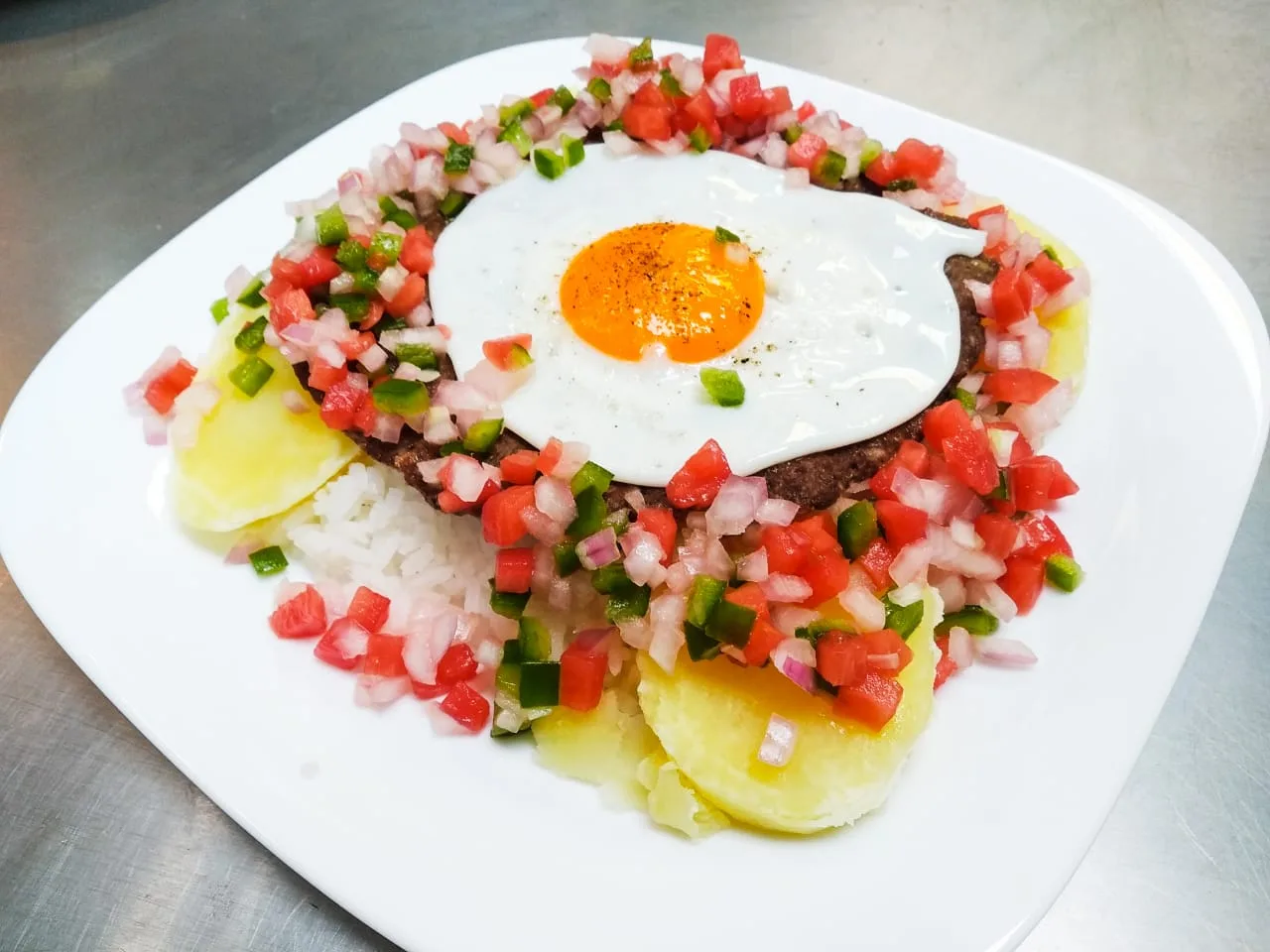
Silpancho with a thin breaded beef steak, fried egg, rice, potatoes and tomato salsa on a white plate Bolivia flag Bolivia 1h 5m
Dinner •Cochabamba Heritage

Silpancho

Silpancho is the great plate of Cochabamba: a bed of white rice and boiled potatoes covered by a single beef steak pounded until it is almost paper-thin, dipped in egg and breadcrumbs and fried crisp, then topped with a fried egg and a fresh salsa of tomato, red onion and hot locoto pepper. The name comes from the Quechua sillp'anchu, meaning flat and thin — and the steak really does cover almost the whole plate. One serving is about 705 g.

Hearty & Satisfying

A plate-sized beef steak pounded paper-thin, breaded and fried over rice and potatoes, crowned with a fried egg and fresh tomato salsa — Cochabamba's most famous plate.

Pairs Well With
Chicha or cold beer & llajua hot sauce
Pique macho platter piled with beef, sausage, fries, tomato, onion, peppers, egg and sauces Bolivia flag Bolivia 55m
Dinner •Cochabamba Heritage

Pique Macho

Pique macho is a mountain of a meal from Cochabamba: strips of beef and pork sausage fried with onion, piled over a heap of french fries with tomato, hot locoto peppers and sliced boiled egg, then finished with zigzags of mustard, mayonnaise and ketchup. It is served in the middle of the table, made to be shared, and its name is a dare — pique, macho means roughly eat it, man. One serving (a quarter of the platter) is about 508 g.

Hearty & Satisfying

A heaped sharing platter of fried beef and sausage over french fries, with tomato, locoto, egg and sauces — Cochabamba's famous dare of a dinner, made for the middle of the table.

Pairs Well With
Cold beer & llajua hot sauce
A plate of sajta de pollo with chicken in orange-yellow aji sauce, boiled potato, grey tunta and fresh onion-tomato sarsa Bolivia flag Bolivia 1h 25m
Dinner •La Paz Heritage

Sajta de Pollo

This sajta de pollo recipe simmers bone-in chicken in a thick sauce of aji amarillo, onion, garlic and cumin, with green peas stirred through, and serves it with boiled potatoes, chuno (freeze-dried Andean potato) and a bright sarsa of onion and tomato. It is the dish La Paz cooks for Carnival and All Saints' Day. One serving is about 566 g.

Comfort & Warmth

Bone-in chicken simmered in a thick yellow aji sauce, served with potatoes, chuno and a fresh onion-tomato sarsa — the festive plate of La Paz.

Pairs Well With
Warm chicken in aji sauce with potatoes, chuno, rice and sarsa
High Protein

The Dinner Gazette

Never wonder what’s for dinner again

One email a week with easy dinner ideas from around the world — ingredients, steps and nutrition, tested in our kitchen first.

Delivered every Thursday morning. Unsubscribe anytime.