Curated recipes from 193 countries  •  New seasonal Mediterranean issue out now

Overview

Vietnamese Tiết Canh

Tiết Canh Vịt, Duck Blood Pudding, Vietnamese Blood Pudding, Vietnamese Raw Blood Jelly

WARNING: This dish is made from raw duck blood and eating it is NOT recommended. Raw blood can carry Streptococcus suis (which causes meningitis and sepsis — people in Vietnam have died after eating pig-blood tiet canh), avian influenza from duck blood, salmonella and other dangerous germs. Vietnam's Ministry of Health advises against eating tiet canh, and no preparation method — not even blood from a fresh or trusted source — makes raw blood fully safe. This page describes the traditional Hanoi preparation, tiết canh vịt, for cultural knowledge only. One serving is about 241 g: a small bowl of fresh duck blood mixed with fish sauce, poured over finely chopped cooked duck meat and left to set into a soft, trembling jelly, then finished with crushed roasted peanuts, fresh herbs, lime and chili, and served cold.

Tiết canh is a long-standing dish of northern Vietnam, and the duck version, tiết canh vịt, is the best-known form in Hanoi, where it is served at family gatherings and celebrations. The name joins tiết, blood, with canh, a savoury broth or soup. The blood is drawn fresh, mixed with fish sauce to keep it liquid, poured over finely chopped cooked duck meat, and left to set into a soft jelly, then finished with peanuts, herbs, lime and chili. Health authorities in Vietnam have long warned against the dish, and in 2009 the agriculture ministry called for a ban on selling it, yet it remains a familiar sight at festive meals in the north.

Pairs well with: Fresh herbs, lime wedges, sliced chili and rice crackers on the side.

Provenance

Vietnam flag Vietnam

Hanoi Heritage

East & South Asia

Time Dedication

1h 10m

30m prep • 40m cook

Batch Yield

4 Servings

228 kcal per serving

1 serving ≈ 241 g

Technical Skill

Intermediate

Medium (Raw Dish — Timing Matters)

Meal Timing & Digestive Fit

Breakfast

Not Advised

Lunch

Inappropriate

Dinner

Inappropriate

Snack & Tea

Ideal Light Bite

Occasions: Family celebrations, festive gatherings in northern Vietnam, shared snack plates Cost: Low — about $2–3 per serving at home

Six small bowls of Vietnamese duck blood pudding topped with roasted peanuts, with fresh herbs and a green chili on a metal tray

Hanoi Heritage

Photo: Lê Huỳnh Bộ, CC BY-SA 4.0, via Wikimedia Commons

The Heritage Formulary

Measured Ingredients

Estimated cost: Low — about $2–3 per serving at home (USD)
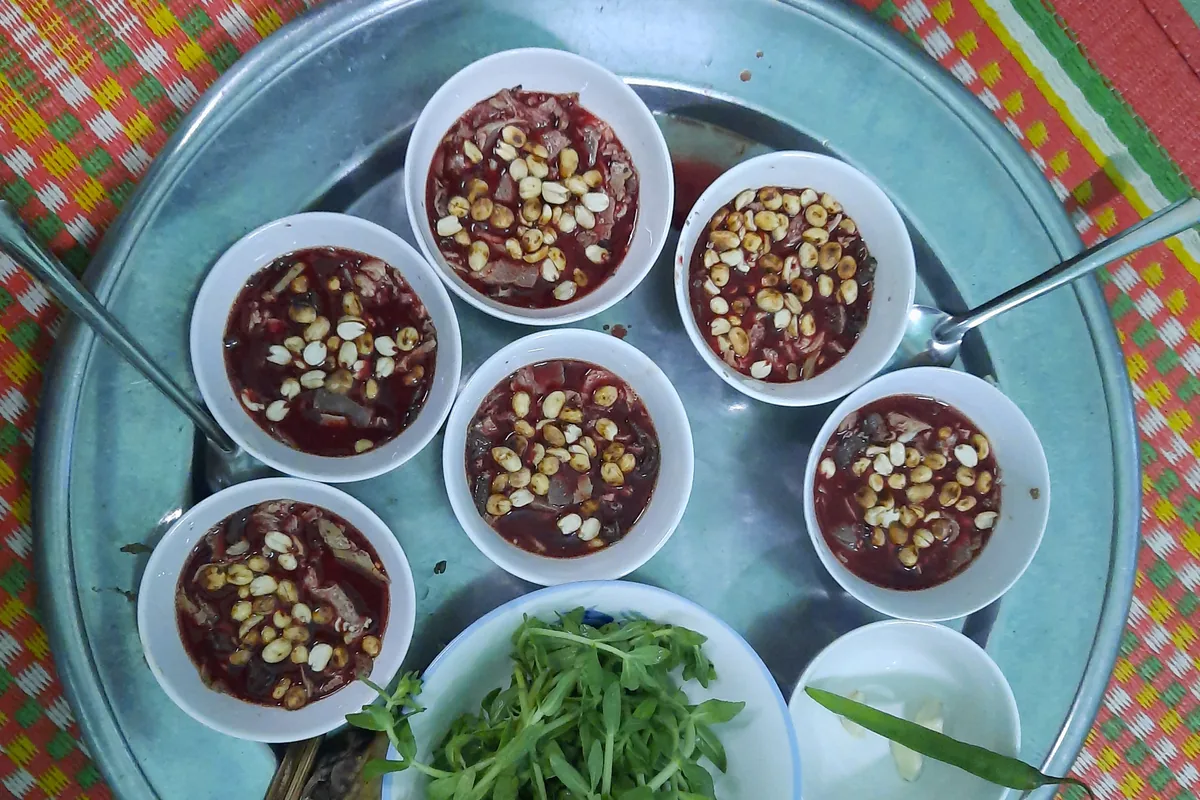
The traditional Hanoi version: fresh duck blood, fish sauce, cooked duck meat, peanuts and herbs, served cold in small bowls.

Execution Methodology & Culinary Technique

Step-by-Step Cooking Guide

Active 1h 10m
P

Prep Stage: Meat, Peanuts & Herbs

30 Mins • Cooking & Chopping

Simmer the gizzards and neck meat in salted water for about 25 minutes until tender, then lift them out, reserve 250 ml of the broth and leave it to cool completely. While the meat cools, roast and crush the peanuts, grill and chop the shallot, and wash and chop the herbs. Chop the cooled meat finely and season it with black pepper.

Maestro Tip: Do all the cooking and chopping first — once the blood is mixed with the fish sauce, the bowls must be filled at once, so everything else should already be ready.

  1. 1

    Simmer the Gizzards & Neck Meat

    25 Mins Simmering, ~95°C (203°F)

    Put the gizzards and neck meat in a pot, cover with water, add a pinch of salt and simmer gently for about 25 minutes until tender. Lift the meat out and reserve 250 ml of the broth, then leave the broth to cool completely. Let the meat cool, then chop it very finely and season with the black pepper.

    The meat must be cooked right through — check that the thickest piece reaches 74°C (165°F) inside before you take it off the heat.

    Done when: Tender meat that cuts easily, with no pink left, and a clear savoury broth.

  2. 2

    Mix the Blood with Fish Sauce

    5 Mins Room temperature, ~25°C (77°F)

    Pour the fresh duck blood into a bowl and stir in the fish sauce at once, mixing well so the blood stays liquid and does not clot early. Work quickly and do not let the blood sit. This step only keeps the blood liquid — it does not make raw blood safe to eat.

    Stir in one direction with chopsticks until the blood and fish sauce are fully combined and smooth.

    Done when: A smooth, free-flowing dark red liquid with no lumps.

  3. 3

    Fill the Bowls

    10 Mins Room temperature, ~25°C (77°F)

    Divide the chopped meat, grilled shallot and chopped herbs evenly among 4 small bowls, pressing the mixture lightly into a flat layer so the blood can cover it evenly.

    Use shallow bowls, not deep ones — a thin layer sets faster and more evenly.

    Done when: Four bowls with an even, flat layer of meat and herbs.

  4. 4

    Dilute, Pour & Set

    15 Mins Room temperature, ~25°C (77°F), then chill

    Stir the cooled broth into the blood and fish sauce mixture, then pour it quickly and evenly over the meat in each bowl. Leave the bowls completely still for about 15 minutes until the blood sets into a soft jelly. If not serving at once, chill the bowls at 4°C (39°F).

    Do not move, shake or tilt the bowls while they set — any movement breaks the jelly and it will not set again.

    Done when: The surface holds the mark of a spoon pressed lightly on it, and the jelly trembles but does not run.

  5. 5

    Garnish & Serve Cold

    5 Mins Serve chilled, 4°C (39°F)

    Scatter the crushed peanuts, remaining herbs and sliced chili over each set bowl, and serve at once, cold, with lime wedges on the side for squeezing over the top. Eat immediately — do not leave the bowls standing at room temperature.

    Serve the moment the garnish goes on: the pudding is at its best in the first minutes after setting.

    Done when: A glossy, set jelly topped with peanuts and herbs, served cold.

Finishing Touches & Plating

Scatter the peanuts and herbs over each set bowl, add chili and a lime wedge, and serve cold at once — the pudding is at its best in the first minutes after setting.

Nutritional Physiology & Benefits

Nutrition

Energy

228

kcal / serving

Protein

30g

Complete AA

Carbs

7g

Complex

Fats

9g

Healthy

Per serving (4 servings · 1 serving ≈ 241 g)
Energy228 kcal
Protein30 g
Carbohydrates7 g
Fat9 g
Fibre1.4 g
Sugar1.3 g
Sodium1125 mg
Per 100g
Energy94 kcal
Protein12.6 g
Carbohydrates2.9 g
Fat3.6 g
Fibre0.6 g
Sugar0.6 g
Sodium467 mg

Nutrition values are estimated — calculated from USDA FoodData Central values for the listed ingredients.

Vitamins & minerals: The blood and duck meat supply iron and vitamin B12, while lime and fresh herbs add vitamin C. Nutrition values are estimated.

Protein in Every Bowl

One serving carries about 30.3 g of protein from the blood and cooked duck meat, so a small 241 g bowl is filling for its size.

Light on Calories

A serving has about 228 kcal, which is light for a 241 g portion, because the dish is mostly blood and broth with a little meat and peanuts.

Fresh Herbs & Lime

Mint, cilantro and Vietnamese coriander, plus lime, add fresh flavour and vitamin C without adding fat or much salt of their own.

Food Pairings

What to Eat With

To optimize nutrient absorption and elevate the sensory depth, pair with these authentic accompaniments:

Sides

Rice Crackers

Crisp, plain rice crackers give a dry crunch against the soft, trembling jelly, and their neutral flavour lets the blood pudding lead.

Vegetables

Fresh Herb Plate

A plate of mint, Vietnamese coriander, perilla and cilantro is the traditional partner — the cool, fragrant leaves cut through the rich blood and refresh the mouth between spoonfuls.

Drinks

Cold Green Tea

Unsweetened iced green tea is the everyday Vietnamese partner for a rich snack, and it cleanses the palate without adding sugar.

Full Menus

A Cooked Main Beside It

Serve the bowls as a small shared snack next to a fully cooked main, such as grilled duck or stir-fried morning glory, so the table has a hot, cooked dish as its centre.

Complete menu

Serve the four small bowls of tiet canh as a shared snack with a plate of fresh herbs, rice crackers and iced green tea, next to a fully cooked main such as grilled duck.

Digestive Guardrails

What NOT to Combine

To prevent digestive distress, sluggishness, or palate clash, avoid pairing the dish with these elements:

Raw Blood — Serious Infection Risk

This dish is served raw, and eating raw blood is NOT recommended. Raw pig blood can carry Streptococcus suis, which causes meningitis and sepsis — people in Vietnam have died after eating pig-blood tiet canh — and raw duck blood can carry avian influenza, salmonella and other dangerous germs. Vietnam's Ministry of Health advises against eating tiet canh, and no preparation method makes raw blood fully safe, not even blood from a fresh or trusted source. People with open cuts or wounds must also avoid this dish — Streptococcus suis can enter the body through broken skin. This is general food information, not medical advice — talk to a doctor if you have any health concerns.

Peanuts — Allergy Risk

Each bowl is topped with crushed roasted peanuts, so anyone with a peanut allergy must not eat this dish at all — the peanuts cannot be picked off safely. This is general food information, not medical advice.

Leftovers & Warm Storage

Raw blood spoils very fast. Discard any bowl left standing at room temperature for more than 2 hours, and never keep leftovers for another day — the dish must be eaten fresh, straight after setting. This is general food information, not medical advice.

General information only, not medical advice — consult a doctor for personal dietary decisions.

Who Should Eat It

Who Should Eat

  • General adultsEating raw blood is not recommended for anyone, including healthy adults. Adults who still choose to eat it should know the risks first: Streptococcus suis, avian influenza and salmonella, with no preparation that makes the dish fully safe.
  • ChildrenChildren must not eat this dish. Their bodies are more vulnerable to meningitis and sepsis from Streptococcus suis and to other infections carried by raw blood.
  • ElderlyOlder adults must avoid this dish. Weaker immune defences make a serious infection from raw blood more likely and harder to recover from.
  • Pregnant womenPregnant women must not eat this dish. An infection from raw blood can harm both mother and baby, and there is no safe way to prepare it.
  • Breastfeeding womenBreastfeeding women must not eat this dish. The infection risk from raw blood is not worth taking while nursing a baby.
  • AthletesThe dish carries about 30.3 g of protein per serving, but that does not outweigh the infection risk. Athletes should get their protein from fully cooked meat, eggs or fish instead.
  • Weight gainAt about 228 kcal per serving it is a light snack, not a useful food for gaining weight — and the raw blood risk applies whatever the goal.
  • Weight lossA serving is low in calories at about 228 kcal, but a raw blood dish is not a safe way to manage weight — choose cooked, low-calorie foods instead.

Health Conditions — Adjust or Avoid

Conditions

  • DiabetesThe dish is low in carbohydrate, but diabetes weakens the body's defences against infection, so raw blood is a bad risk. Do not eat it. Ask your clinician about safe alternatives.
  • High blood pressureOne serving carries about 1125 mg of sodium, mostly from the fish sauce, which is very high for a single snack. Do not eat it. Ask your clinician about portions.
  • Kidney diseaseThe high sodium and the protein load both matter for kidney diets, and raw blood adds an infection risk. Do not eat it. Ask your clinician about portions.
  • GoutBlood and organ meat are high in purines, which can raise uric acid. Do not eat it. Ask your clinician about portions.
  • Stomach issuesRaw food, chili and lime can all irritate a sensitive stomach, and a foodborne infection would be worse still. Do not eat it. Ask your clinician about portions.
  • Cardiovascular diseaseThe sodium load of about 1125 mg per serving is a problem for heart health, and raw blood carries an infection risk. Do not eat it. Ask your clinician about portions.
  • Fatty liverPeople with liver disease are among those who must avoid this dish — the liver is a key defence against blood-borne infection, and raw blood can overwhelm it. Do not eat it. Ask your clinician about portions.
  • Food allergiesContains peanuts (a major allergen), fish (fish sauce) and duck. Anyone allergic to peanuts, fish or duck must not eat it. Ask your clinician about safe alternatives.
  • Special therapeutic dietsThis dish does not fit low-sodium, low-purine or immune-compromised therapeutic diets, and it cannot be made safe by changing a garnish. Ask your clinician about safe alternatives.

If you have a medical condition, consult your doctor before changing your diet.

Storage & Use

Storage & Use

How to store
Do not store this dish — serve it immediately after setting and discard any leftovers.
In the fridge
If a bowl must wait, keep it at 4°C (39°F) for no more than 2 hours, covered. Do not refrigerate it for later eating.
In the freezer
Do not freeze. Raw blood pudding does not freeze safely and its texture is ruined by freezing.
How to reheat
Do not reheat — heating changes the dish entirely. Anyone wanting a cooked blood dish should cook blood fully to 74°C (165°F) as a different, fully cooked dish.
Freezing recommended
No — never freeze this dish.
Signs it has spoiled
Sour or off smell, grey or brown discoloration, a slimy surface, or liquid separating from the jelly — discard at once.

More recipes to explore

A bowl of Vietnamese phở bò with rare beef, rice noodles and fresh herbs Vietnam flag Vietnam 3h 30m
Breakfast •Hanoi Heritage

Phở Bò Tái Nạm

Slow-simmered star anise and cinnamon bone broth with hand-cut rice noodles, supplying clean restorative warmth and collagen. One serving is about 775 g.

Immunity & Warming

Slow-simmered bone broth with rice noodles, rare beef and fresh herbs.

Pairs Well With
Crispy quẩy, fresh lime & sawtooth coriander
Soups & Broths • High Protein
Gỏi cuốn — Vietnamese fresh spring rolls with prawn and pork Vietnam flag Vietnam 1h 5m
Snack & Tea •Saigon Refresh

Gỏi Cuốn Tôm Thịt

Fresh rice paper rolls filled with poached prawns, tender pork, rice vermicelli, lettuce, herbs and carrot, served with a peanut dipping sauce.

Light Digestion

Nothing is fried, so the rolls stay light and fresh — a cool, herb-filled snack for hot days.

Pairs Well With
Artisanal Peanut Dip & Fresh Lotus Root Water
High Protein
Vietnamese braised pork belly with golden eggs in caramel sauce Vietnam flag Vietnam 1h 45m
Dinner •One Pot

Vietnamese Braised Pork and Eggs

Pork belly slowly braised in coconut water and caramel until meltingly tender, with golden eggs that soak up the sweet-savoury sauce — the Vietnamese family dish that tastes better the next day.

Comfort & Sustained Energy

Slow-braised pork belly and eggs in coconut water and caramel.

Pairs Well With
Steamed rice & pickled mustard greens
High Protein
Pan con tomate with jamón ibérico on toasted bread Spain flag Spain 15m
Snack & Tea •Catalan Aperitivo

Pan con Tomate & Jamón Ibérico

Country bread rubbed with ripe Ramallet tomato, drizzled with cold-pressed Arbequina olive oil and topped with jamón ibérico.

Vascular Health

Toasted tomato bread with jamón ibérico, olive oil and olives.

Pairs Well With
Castelvetrano Olives & Sparkling Mineral Water
Quick Prep (<30m)

The Dinner Gazette

Never wonder what’s for dinner again

One email a week with easy dinner ideas from around the world — ingredients, steps and nutrition, tested in our kitchen first.

Delivered every Thursday morning. Unsubscribe anytime.