-
1
Debone and Season the Hen
30 Mins
Room temperature, about 20°C (68°F)
If the butcher has not deboned the hen, do it yourself: cut along the backbone, work the meat away from the bones with a sharp knife, and keep the skin in one piece. Lay the hen skin-side down on the board, rub it all over with the lemon juice, half the salt and half the pepper, and leave it while you make the stuffing.
A sharp, narrow boning knife and a cold bird make deboning far easier — warm skin tears.
Done when: A flat hen with the skin whole and unbroken, seasoned on the meat side.
-
2
Make the Chicken Mousse Stuffing
15 Mins
Room temperature, about 20°C (68°F)
Put the 600g of cubed chicken breast and the remaining salt in a food processor and grind to a smooth, even paste. Add the coriander, spring onion and egg and grind again until combined. Add the 120g of cream and pulse for no more than 30 seconds, then tip the paste into a bowl and fold in the celery, carrot and aji dulce with a spoon — do not blend them, they should stay in visible pieces.
Stop the processor the moment the cream is in — over-beating turns the mousse rubbery.
Done when: A smooth pale paste that holds its shape on a spoon, studded with green, orange and red vegetable pieces.
-
3
Stuff, Roll and Tie the Hen
15 Mins
Room temperature, about 20°C (68°F)
Spread the stuffing evenly over the meat side of the hen, leaving a 3 cm border all round. Roll the hen up firmly from one side into a cylinder, then set it on the cheesecloth, wrap it tightly like a sweet, and tie both ends with kitchen string. Tie two more loops of string around the middle so the roll keeps its shape.
Roll tightly and tie firmly — a loose roll lets the stuffing escape into the stock.
Done when: A firm, even cylinder wrapped in cloth, tied at both ends and twice around the middle.
-
4
Poach Gently in Stock
180 Mins
Gentle simmer, about 85°C (185°F)
Lower the wrapped roll into the tall pot with the 2 litres of stock — it must be fully covered. Keep the liquid at a gentle simmer, never a rolling boil, for 3 hours, turning the roll once halfway and topping up with hot water if the level drops. Check the centre of the roll with a thermometer: it must reach at least 74°C (165°F).
A boil will burst the cloth and cloud the stock; the barest simmer, with only a few bubbles, is right.
Done when: A firm roll that feels set through, with the centre at least 74°C (165°F).
-
5
Rest, Brown and Make the Sauce
20 Mins
High heat, about 200°C (400°F)
Lift the roll out, rest it for 10 minutes, then unwrap the cloth carefully. Heat the 15g of olive oil in a large pan over high heat and brown the roll on all sides, about 2 minutes per side, until the skin is golden. Meanwhile, skim the fat from the poaching liquid, take 400 ml of it and boil it down to about 200 ml of glossy sauce; season it lightly if needed.
Rest before browning — a hot roll straight from the pot will fall apart in the pan.
Done when: Golden-brown skin all over, and a glossy sauce that coats the back of a spoon.
-
6
Slice and Serve
10 Mins
Hot, about 75°C (170°F)
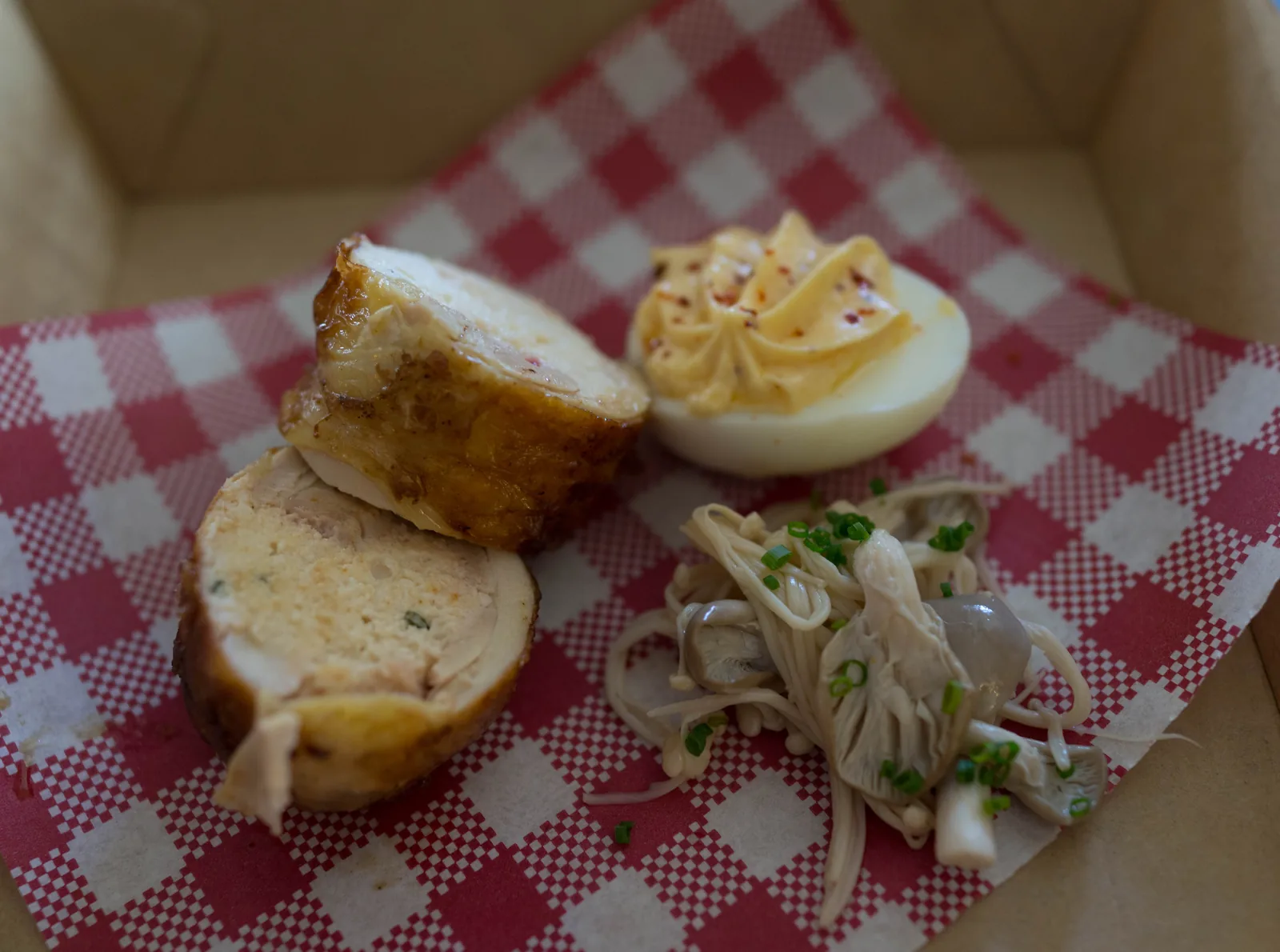
Set the roll on a board and cut it into slices about 1 cm thick with a sharp knife, wiping the blade between cuts. Arrange two or three slices per person on warm plates and spoon the reduced sauce over the top.
A long, sharp knife and a wiped blade give clean slices that show the pale filling ringed by the hen.
Done when: Neat 1 cm slices, pale filling visible inside a ring of hen meat, sauce spooned over.
auto_awesome Finishing Touches & Plating
Serve the sliced gallina rellena warm, two or three slices per person, with the reduced pan sauce spooned over and sweet potato puree alongside. Any leftover slices are just as good cold the next day, thinly sliced for sandwiches.

 Venezuela
3h