-
1
Salt and Dry the Pig
45 Mins
Room temperature, ~20°C (68°F)
Rinse the pig inside and out under cold running water, then pat the skin very dry with clean towels. Rub half the salt (30 g) all over the inside of the cavity and the rest over the skin. Leave the pig uncovered in a cool, airy place for 30 minutes so the skin dries out — the surface should feel dry and slightly tacky to the touch before it goes on the spit.
Do not skip the drying time. A damp skin turns leathery instead of glassy, and no amount of hot coals later will fix it.
Done when: The skin is dry and tacky to the touch, with no wet patches.
-
2
Stuff the Cavity and Truss
30 Mins
Room temperature, ~20°C (68°F)
Pack the cavity tightly with the bruised lemongrass, crushed garlic, quartered onions, spring onions, cracked pepper, bay leaves and star anise — press the stuffing in firmly so there are no air pockets. Sew the belly shut with kitchen twine, truss the legs close to the body, and thread the spit through the mouth and out the rear, balancing the pig so it does not swing to one side. Tie the spit firmly at both ends.
Pack the stuffing tight and sew the belly closed. Loose stuffing falls out during the roast and the cavity collapses, which makes the pig cook unevenly.
Done when: The cavity is sewn shut, the legs are trussed tight, and the pig sits level on the spit without tipping.
-
3
Build the Charcoal Fire
15 Mins
Coals burning down to white ash, ~230°C (450°F)
Build a long, even bed of charcoal directly under where the pig will turn, with a drip pan underneath to catch the fat. Light the charcoal and let it burn down until the coals are covered in white ash and glowing steadily, with no tall flames. Rake the coals into a thinner layer under the belly and a thicker layer under the shoulders and hams, which are the thickest parts.
Flames are the enemy: they scorch the skin black before the meat is cooked. Wait for white ash and steady glow.
Done when: The coals are covered in white ash, glowing evenly, with no flames licking up.
-
4
Spit-Roast Low and Slow
240 Mins
Low, steady heat, ~150–175°C (300–350°F)
Set the spit over the coals and turn the pig slowly and steadily for about 4 hours, never stopping for long. Brush the skin with oil every 30 minutes and push the coals around as needed so no one spot burns — keep the heat gentler under the belly and stronger under the shoulders and hams. The fat will drip into the pan below; the skin will slowly turn from pale to golden to deep mahogany. Check the temperature with a meat thermometer in the thickest part of the ham and the shoulder: it must reach at least 63°C (145°F) and the juices must run clear.
Turn, turn, turn. A pig left still over the fire cooks on one side and burns on the other — steady rotation is the whole skill of lechon.
Done when: The thickest meat reads at least 63°C (145°F) on a thermometer, the juices run clear, and the skin is deep mahogany.
-
5
Crisp the Skin
30 Mins
High heat, coals close, ~230°C (450°F)
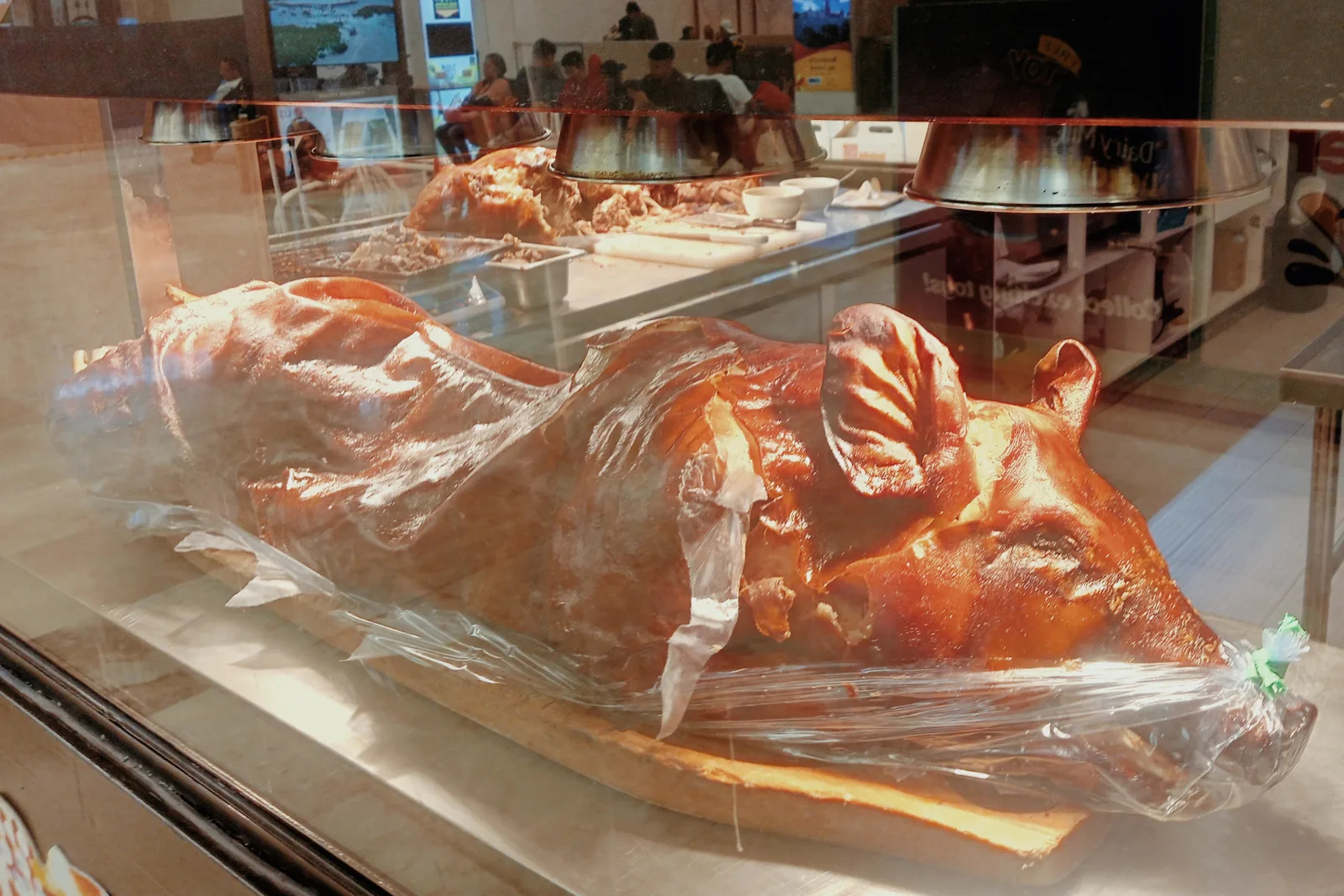
For the last 30 minutes, push the coals closer to the pig and turn it a little faster, brushing the skin with oil as you go. The skin will tighten, blister and lacquer to a deep reddish brown. Tap it with the back of a knife — good lechon skin sounds hollow and hard, and a tap should crack it. Do not let it go black: pull the pig off the moment the skin is crisp all over.
The final blast of heat is what makes the crackle. If the skin is still soft in patches, give those patches the hottest coals for a few minutes — but watch them, because crisp turns to burnt fast.
Done when: The skin is deep reddish brown, blistered and hard; it cracks under a tap from a knife.
-
6
Rest and Carve
30 Mins
Resting, cooling to ~60°C (140°F)
Lift the pig off the spit and lay it on a banana-leaf-lined board. Pull the stuffing out of the cavity and discard the lemongrass stalks, bay leaves and star anise — they have given all their flavour to the meat. Rest the pig for 20–30 minutes so the juices settle, then carve: crack the skin off in large shards first, then slice the meat. Serve the crackling immediately, while it is still shattering-crisp.
Rest the pig before carving, or the juices run out onto the board instead of staying in the meat. And carve the crackling first — it softens within minutes once it is off the pig.
Done when: The meat has rested, the juices have settled, and the crackling is still crisp when served.
auto_awesome Finishing Touches & Plating
Carve at the table if you can — the crack of the skin under the cleaver is half the show. Serve the crackling first while it is still shattering-crisp, then the juicy meat with rice, atchara and the spiced vinegar dip.

 Philippines
1h 5m