-
1
Slice & Pound the Beef Thin
15 Mins
Cold, from the freezer
Take the chilled beef and slice it into long, thin sheets, 3–4 mm thick, cutting against the grain. Lay each sheet between two pieces of cling film and pound gently with a meat mallet or rolling pin until it is almost translucent. Rub half the salt over both sides of every sheet.
Hold a sheet up to the light — if you can almost see through it, it is thin enough.
Done when: Sheets are 3–4 mm thin, even, and almost translucent when held up.
-
2
First Dry — Until the Surface Is Dry
180 Mins
Low oven, 75°C (167°F), door slightly ajar
Lay the sheets in a single layer on wire racks over lined baking sheets, not touching each other. Dry in a low oven at 75°C (167°F) with the door slightly ajar for about 3 hours, until the surface feels dry to the touch and the sheets are still flexible. The beef must reach 71°C (160°F) inside, which this temperature achieves. In strong, dry sunshine the traditional sun-drying takes a full day instead.
Keep the door slightly ajar so the moisture escapes — a sealed oven steams the meat instead of drying it.
Done when: Surface is dry to the touch; sheets are flexible, not wet or sticky.
-
3
Make the Labu Paste
10 Mins
Room temperature
While the beef dries, mix the ground peanuts, ginger, cayenne, paprika, garlic powder, onion powder, cloves, nutmeg, remaining salt and crushed stock cube in a bowl. Add the groundnut oil and a little water, a spoonful at a time, and stir until you have a thick, spreadable paste about the consistency of thick peanut butter.
Add the water slowly — a paste that is too thin slides off the meat, and a paste that is too thick cracks as it dries.
Done when: A thick, smooth, rust-red paste that holds its shape on a spoon.
-
4
Coat & Marinate
60 Mins
Room temperature, then fridge
Brush or spread the labu paste evenly over both sides of every partially dried sheet, massaging it in by hand so the coating is thin and even. Stack the coated sheets on a plate, cover, and leave for 1 hour at room temperature, or overnight in the fridge for deeper flavour.
A thin, even coat dries into a crisp crust; a thick coat stays soft in the middle and can spoil.
Done when: Every sheet is evenly coated on both sides with a thin layer of paste.
-
5
Second Dry — Until Rigid
180 Mins
Low oven, 75°C (167°F), door slightly ajar
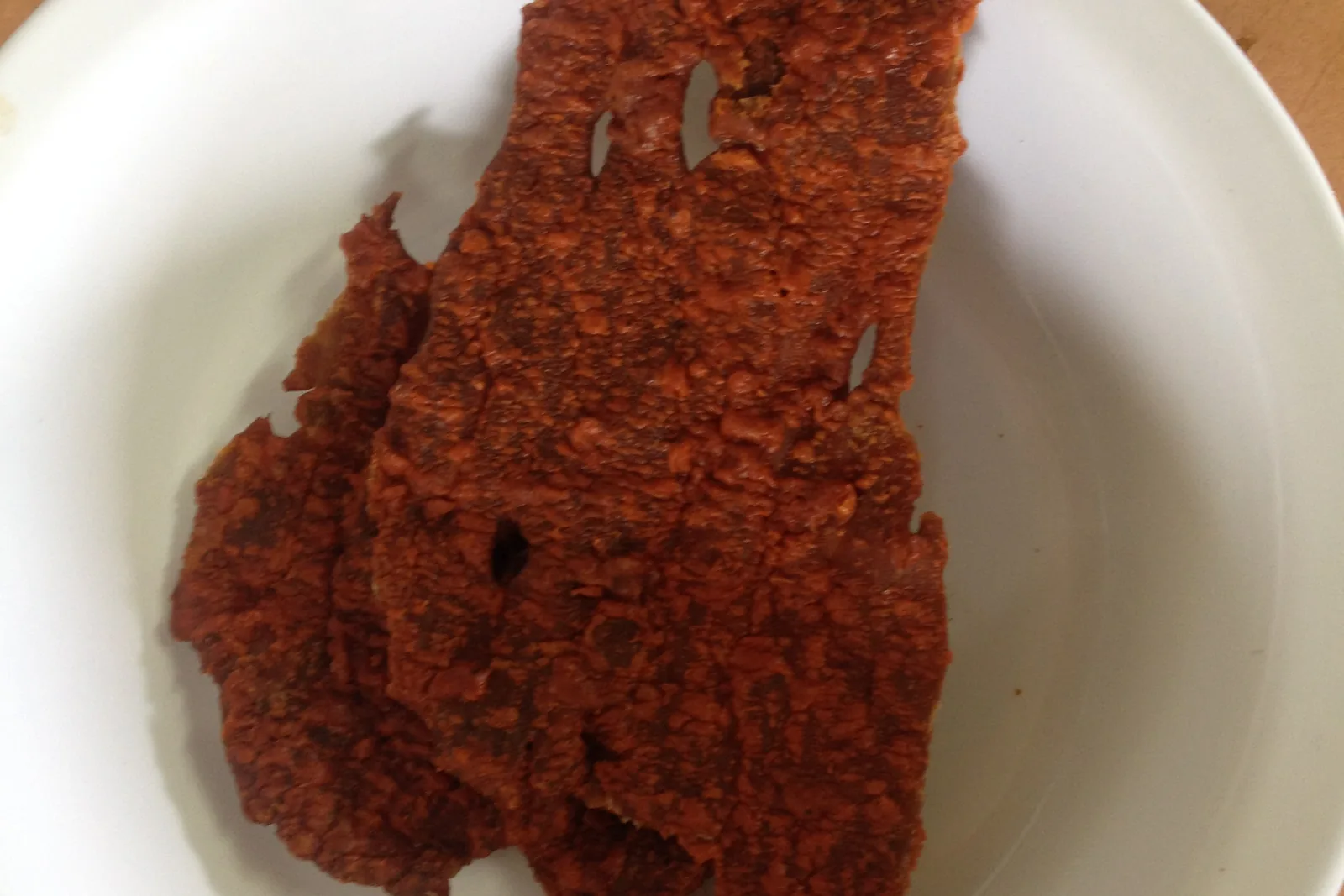
Return the coated sheets to the wire racks in a single layer and dry again at 75°C (167°F) with the door slightly ajar for about 3 hours, flipping once halfway. The kilishi is ready when the paste is completely dry and set, and the sheets are rigid and snap cleanly when bent.
Flip the sheets halfway so both sides dry evenly — the side facing down stays damp otherwise.
Done when: Paste is dry and set; sheets are rigid and snap cleanly like a cracker.
-
6
Flash-Roast & Cool
10 Mins
180°C (350°F)
Heat the oven to 180°C (350°F). Lay the dried sheets on a clean baking sheet and roast for 10 minutes, turning once, until the coating darkens slightly and smells toasty. Cool completely on the rack before eating or storing — the kilishi crisps further as it cools.
Watch the last minutes closely — the peanut coating goes from toasty to burnt very fast at this heat.
Done when: Coating is a deeper rust-red and smells toasty; sheets are crisp when cool.
auto_awesome Finishing Touches & Plating
Eat the kilishi as a snack, torn into strips, with sliced raw onion on the side. A little goes a long way — it is intensely flavoured, so serve small pieces and let people come back for more.
 Niger
1h 10m

 Spain
 Vietnam