-
1
Beat the Eggs and Icing Sugar
15 Mins
Room temperature eggs, about 20°C (68°F)
Put the eggs and the sifted icing sugar in a large bowl and beat with an electric whisk for a full 10 minutes, until the mixture is very pale, thick and tripled in volume — it should fall from the whisk in a ribbon that holds its shape for a few seconds. This long beating is what gives the cookies their lift, so do not cut it short.
Room-temperature eggs whip up much higher than cold ones — take them out of the fridge an hour ahead.
Done when: A pale, thick ribbon that holds its shape for a few seconds before sinking.
-
2
Mix the Dough and Rest It
10 Mins + 10 Mins Rest
No heat — room temperature, about 20°C (68°F)
Sift the flour, baking powder and salt over the egg paste, add the crushed anise seed, and fold everything together with a spatula until a stiff, smooth dough forms. Turn it onto a lightly floured surface and knead briefly — just until smooth. Cover and let it rest for 10 minutes so the flour hydrates and the dough relaxes.
Do not over-knead: a tough dough cracks in the mould and loses its picture.
Done when: A stiff, smooth dough that holds its shape and does not stick to your hands.
-
3
Roll, Mould and Cut
20 Mins
No heat — room temperature, about 20°C (68°F)
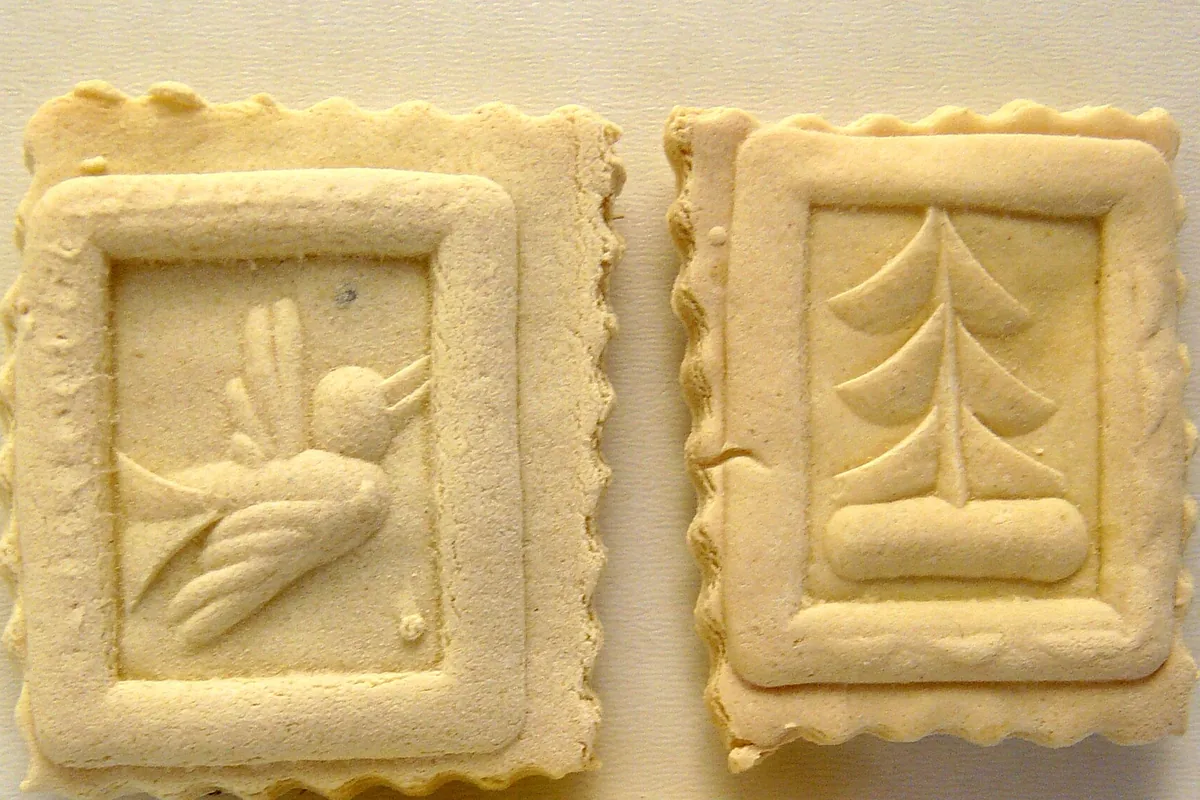
Roll the dough out about 8 mm thick on a lightly floured surface. Flour a springerle mould and press it firmly and evenly into the dough, then lift it straight up. Cut around each picture with a sharp knife or pastry wheel. Scatter the remaining whole anise seed over the lined baking trays and lift the cookies onto them, picture side up, spacing them 2 cm apart.
Press once, hard and even — rocking the mould blurs the picture.
Done when: Clean-cut cookies with a sharp, deep picture, sitting on a scattering of anise seed.
-
4
Dry Overnight
24 Hours Drying (Overnight)
Room temperature, about 20°C (68°F)
Leave the trays uncovered in a cool, draught-free room for 24 hours. The tops must feel completely dry to the touch — a skin forms over the picture, and that skin is what keeps the design crisp while the base rises into a little foot in the oven. Do not cover the trays, and do not rush this step.
A cold oven, switched off, is a perfect draught-free drying cupboard — just remember the trays are in there.
Done when: Tops dry and firm to the touch, with the picture still sharp.
-
5
Bake Low and Pale
20 Mins
150°C (300°F)
Preheat the oven to 150°C (300°F), without the fan, and leave the door very slightly ajar if your oven allows it. Bake the dried cookies for about 20 minutes, until they are set and firm, very white on top and light golden underneath. Do not let the tops take on any colour. Cool completely on a wire rack.
Bake one test cookie first — ovens vary, and a browned top cannot be undone.
Done when: Firm and dry, white on top with a pale golden base and a small foot underneath.
auto_awesome Finishing Touches & Plating
Cool the cookies completely on a wire rack, then pack them into an airtight tin with a few extra anise seeds. They are hard at first and soften over one to two weeks — that is when they taste their best.

 Switzerland
40m