-
1
Salt and Dry the Pig
45 Mins
Room temperature, ~20°C (68°F)
Rinse the pig inside and out under cold running water, then pat the skin very dry with clean towels. Rub half the salt (25 g) all over the inside of the cavity and the rest over the skin, working it into every fold. Leave the pig uncovered in a cool, airy place for 30 minutes so the skin dries out — the surface should feel dry and slightly tacky to the touch before it is wrapped.
Do not skip the drying time. A damp skin turns leathery instead of crisp, and no amount of fire at the end will fix it.
Done when: The skin is dry and tacky to the touch, with no wet patches.
-
2
Wrap the Pig in Banana Leaves
45 Mins
Room temperature, ~20°C (68°F)
Lay the banana leaves out overlapping on a clean mat or table and set the pig in the middle. Fold the leaves up and around the pig, tucking the edges in, until it is wrapped in two or three layers with no gaps. Tie the parcel firmly with coconut-fibre string or kitchen twine so the leaves cannot spring open in the 'umu.
Wrap it tight and tie it well. A loose parcel lets the steam escape and the leaves fall open, and the meat dries out instead of steaming tender.
Done when: The pig is fully enclosed in leaves with no gaps, and the parcel holds its shape when lifted.
-
3
Build the 'Umu and Heat the Rocks
120 Mins
Wood fire heating the rocks, ~400°C (750°F)
Dig a shallow pit about 1.5 m long and 1 m wide, and line the bottom with dry volcanic rocks — never river stones, which can hold water and crack or burst in the heat. Build a wood fire over the rocks and let it burn down for about 2 hours until the rocks are glowing hot and the flames have died to embers. Rake the embers aside and level the rocks into an even bed.
Use only dry volcanic or dense basalt rocks. River stones can explode when heated, and that is dangerous — if a rock hisses or steams, take it out with tongs.
Done when: The rocks are glowing hot with no tall flames, and the pit is an even bed of heat.
-
4
Bury the Pig in the 'Umu
300 Mins
Steam heat inside the 'umu, ~100°C (212°F)
Lay a bed of green banana leaves over the hot rocks, set the wrapped pig on top, and pack the taro, yam and cassava for the feast around it, each in its own leaf parcel. Cover everything with more banana leaves, then with sacking or old mats, and finally with a layer of earth so no steam escapes. Leave the 'umu sealed for about 5 hours. Do not open it to peek — every opening lets the heat and steam out. Check the thickest part of the ham and the shoulder with a meat thermometer: it must reach at least 63°C (145°F) and the juices must run clear. If you have no pit, the home version is the same parcel in a low oven at 150°C (300°F) for 5 hours, in a covered roasting pan with a little water in the bottom for steam.
Seal the 'umu well and leave it alone. The steam trapped under the earth is what cooks the pig — opening the oven is the one thing that can spoil it.
Done when: The thickest meat reads at least 63°C (145°F) on a thermometer, the juices run clear, and the meat pulls easily from the bone.
-
5
Finish Over Open Fire for Crackling
30 Mins
Open flame, ~230°C (450°F)
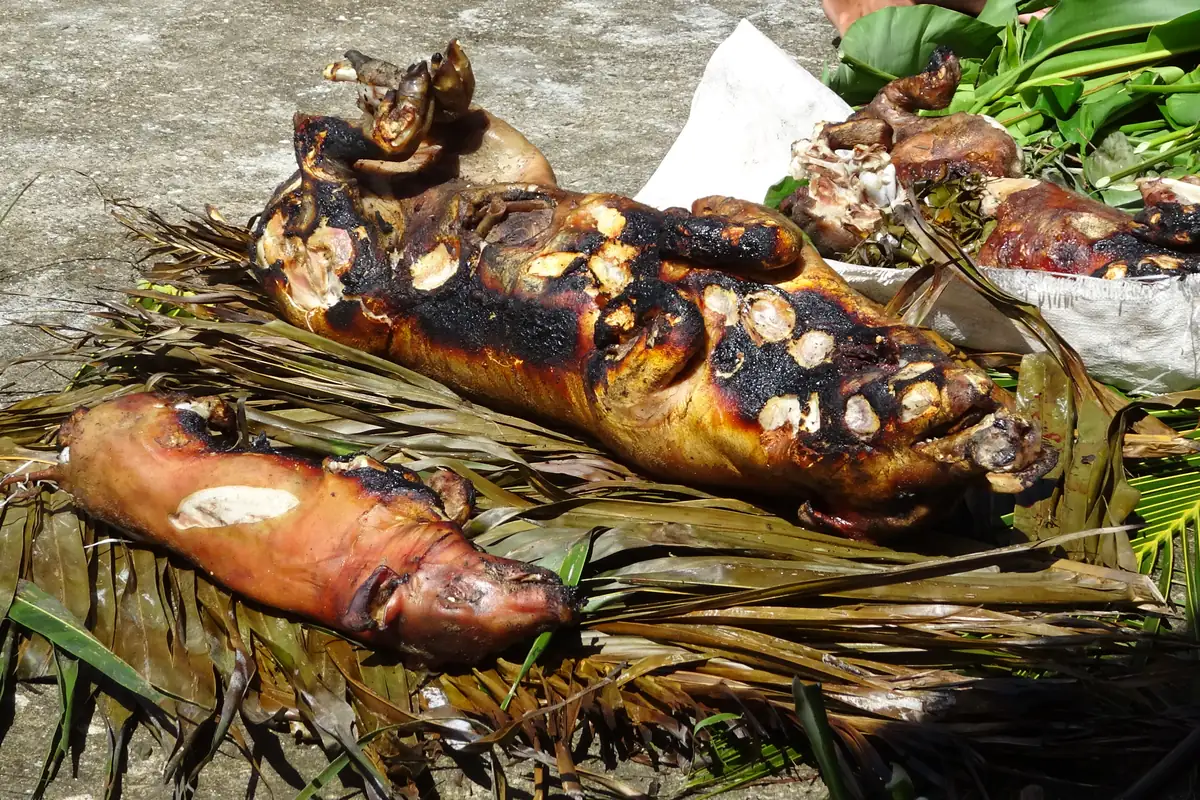
Uncover the 'umu and lift the pig out. Peel the banana leaves away and set the pig on a spit or a sturdy grill over a lively open fire, turning it steadily for about 30 minutes. The skin will tighten, blister and crisp to a deep golden brown. Tap it with the back of a knife — good puaka tunu skin sounds hollow and hard. Do not let it go black: pull the pig off the moment the skin is crisp all over.
Keep the pig moving over the fire. A pig left still scorches on one side and stays soft on the other — steady turning is what makes the crackling even.
Done when: The skin is deep golden brown, blistered and hard; it cracks under a tap from a knife.
-
6
Rest and Carve on the Pola
30 Mins
Resting, cooling to ~60°C (140°F)
Lay the pig on a woven mat (pola) spread with fresh banana leaves. Rest it for 20–30 minutes so the juices settle, then carve: crack the skin off in large shards first, then slice the meat and pile it in the middle of the mat with the taro, yam and cassava from the 'umu. Serve the crackling immediately, while it is still crisp, and let everyone eat with their fingers.
Rest the pig before carving, or the juices run out onto the mat instead of staying in the meat. And carve the crackling first — it softens within minutes once it is off the pig.
Done when: The meat has rested, the juices have settled, and the crackling is still crisp when served.
auto_awesome Finishing Touches & Plating
Carve on the woven mats if you can — the crack of the skin under the cleaver is half the show. Serve the crackling first while it is still crisp, then the smoky meat with taro, yam and lu pulu, and let everyone eat with their fingers.

 Tonga
55m

 France