-
1
Wake the Yeast
10 Mins
Warm milk, about 37°C (98°F)
Pour the warm milk into a large bowl, stir in 1 tablespoon of the sugar and sprinkle over the yeast. Leave for 10 minutes until the surface is foamy and smells yeasty.
Milk hotter than 43°C (110°F) kills the yeast — if it feels hot on your wrist, let it cool first. No foam after 10 minutes means the yeast is dead; start again with a fresh packet.
Done when: A thick, creamy foam covers the milk and it smells faintly of bread.
-
2
Mix and Knead the Dough
20 Mins
Room temperature, about 24°C (75°F)
Whisk the beaten eggs, the remaining sugar, the cooled melted butter, mahlepi, ground mastiha, orange zest and salt into the yeasted milk. Add the flour a cup at a time, mixing until a shaggy dough forms, then knead on a lightly floured surface for 10 to 12 minutes until smooth, soft and elastic.
The dough will feel sticky at first — resist adding much extra flour, or the loaf turns dense. A light dusting on your hands is enough; the dough firms up as the gluten develops.
Done when: The dough is smooth, springs back when poked, and passes the windowpane test: a small piece stretches thin without tearing.
-
3
First Rise
90 Mins
Warm spot, about 24-27°C (75-80°F)
Shape the dough into a ball, place it in a lightly oiled bowl, turn it once to coat, and cover with a damp cloth or cling film. Leave in a warm, draught-free spot until doubled in size, about 90 minutes.
In a cold kitchen, put the covered bowl in the oven with just the light on — the gentle warmth speeds the rise without cooking the dough.
Done when: The dough has doubled and holds a dent when poked gently with a fingertip.
-
4
Shape the Braid
15 Mins
Room temperature, about 24°C (75°F)
Turn the dough out, press out the air gently, and divide it into three equal pieces. Roll each into a rope about 45 cm (18 in) long, pinch the three ends together at the top, and braid them — right over middle, left over middle, repeating — then pinch the ends together and tuck them under. Transfer to a lined baking tray.
Keep the three ropes even in thickness or the braid bakes lopsided. If a rope keeps springing back, let it rest for 5 minutes and roll again.
Done when: A neat, even three-strand braid with tucked ends, lying flat on the tray.
-
5
Second Rise
45 Mins
Warm spot, about 24-27°C (75-80°F)
Cover the braid loosely with a damp cloth and leave it to rise again until puffy and about half as big again, about 45 minutes. Meanwhile, heat the oven to 180°C (350°F).
Do not let the second rise go too far — an over-proved braid collapses in the oven and loses its shape. Puffy and springy is right; wobbly and slack is too far.
Done when: The braid looks puffy and springs back slowly when poked.
-
6
Egg Wash, Almonds and Bake
35 Mins
180°C (350°F)
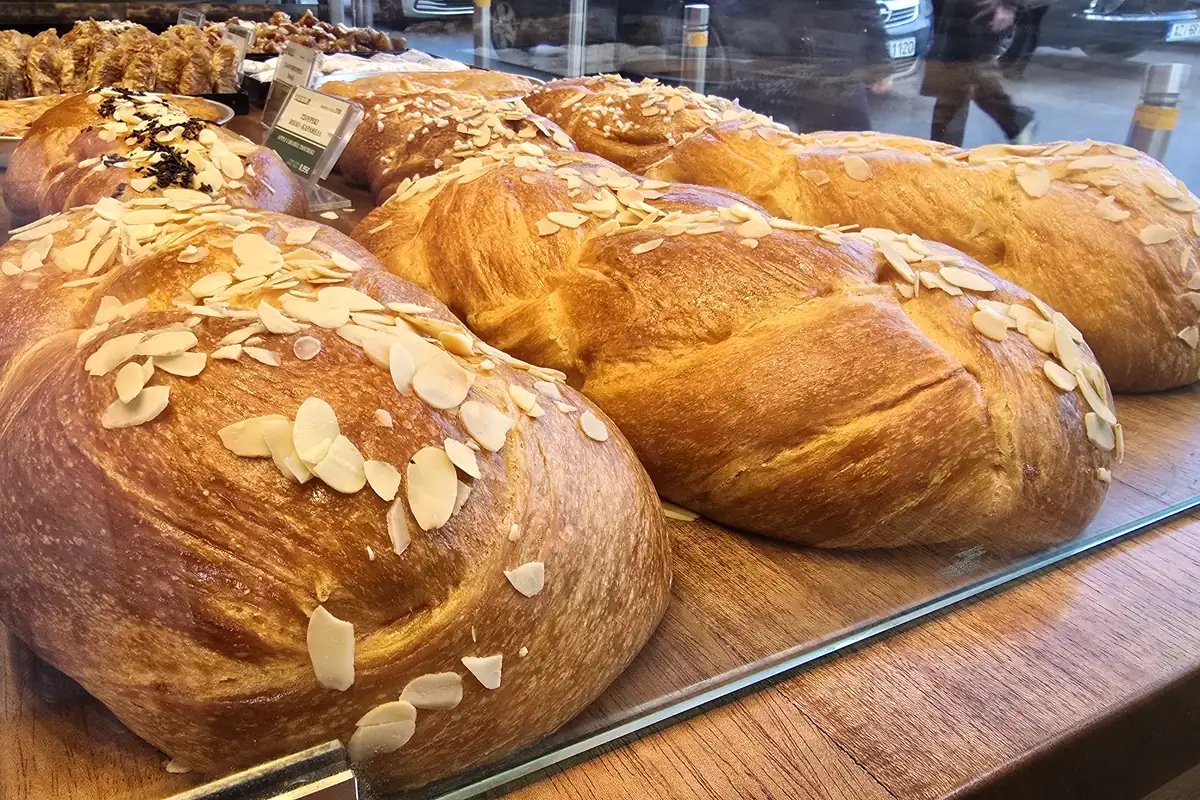
Brush the braid gently all over with the beaten egg wash, taking care not to deflate it, and scatter over the flaked almonds. Bake in the middle of the oven for 30 to 35 minutes until deep golden brown. The loaf is done when it sounds hollow when tapped underneath and the centre reads 88-93°C (190-200°F) on a thermometer.
If the top browns too fast, cover it loosely with foil for the last 10 minutes. Let the loaf cool on a rack for at least 20 minutes before slicing, or the crumb will tear.
Done when: Deep golden crust, hollow sound when tapped, and a centre temperature of 88-93°C (190-200°F).
auto_awesome Finishing Touches & Plating
Cool the loaf on a wire rack for at least 20 minutes before slicing, so the crumb sets and the braid cuts cleanly. Serve thick slices at room temperature, or lightly toasted with butter.

 Greece
2h