-
1
Mix and Knead the Dough
10 minutes
Room temperature, about 22°C (72°F)
Put the flour, sugar and 6 g of salt in a large bowl and whisk to combine. Pour in the lukewarm water a little at a time, mixing with your hand, until a shaggy dough forms. Turn it onto a clean counter and knead for 8–10 minutes until it is smooth, soft and only slightly tacky. If it sticks badly, dust your hands with flour, not the dough — extra flour toughens the layers.
Knead on a bare counter with no flour: the slight grip helps the dough come together, and the gluten you build now is what holds the layers apart later.
Done when: Smooth, elastic dough that springs back slowly when poked; it should feel soft like an earlobe, not stiff.
-
2
Rest the Dough
60 minutes
Room temperature, about 22°C (72°F)
Shape the dough into a ball, rub it lightly with a drop of oil, cover the bowl with a damp cloth or plastic wrap, and leave it to rest for at least 1 hour at room temperature. Do not skip this rest: relaxed dough stretches thin without springing back, and that thin stretch is the whole secret of the layers.
For the flakiest result, rest the dough in the refrigerator overnight, then bring it back to room temperature for 30 minutes before shaping.
Done when: The dough feels slack and relaxed, and a poke leaves a dent that fills back in slowly.
-
3
Boil the Eggs and Make the Resek
10 minutes
Boiling water, 100°C (212°F)
While the dough rests, put the eggs in a small pan, cover with cold water, and bring to a boil. Boil for 10 minutes, then cool under cold running water, peel and slice. For the resek, grate the tomatoes on the coarse side of a box grater into a small bowl, discarding the skin, and stir in the crushed garlic, the olive oil and a pinch of salt.
Cool the eggs under running water right away: it stops the cooking and keeps the yolks bright instead of grey-green around the edge.
Done when: Egg yolks fully set and bright yellow; the resek is spoonable, fresh and lightly salted.
-
4
Laminate: Roll, Butter, Fold and Coil
15 minutes
Room temperature, about 22°C (72°F)
Divide the rested dough into 4 equal balls of about 205 g each. On a lightly buttered counter, roll one ball out as thin as you can — about 30 cm across, thin enough to almost see the counter through it. Smear about 20 g of soft butter over the whole surface with your fingers. Fold the left third over the middle, then the right third over that, like an envelope. Roll the strip into a tight log, then coil the log into a spiral like a snail shell and tuck the end underneath. Repeat with the other balls, cover, and rest 10 minutes.
Work on a buttered surface, not a floured one: flour dusted between the layers stops them sticking together and kills the flake. If the dough resists, let it rest 5 minutes and try again.
Done when: Four neat, flat spirals; the butter is sealed inside the folds, not leaking out.
-
5
Roll Out and Pan-Fry
20 minutes
Medium heat, about 180°C (350°F)
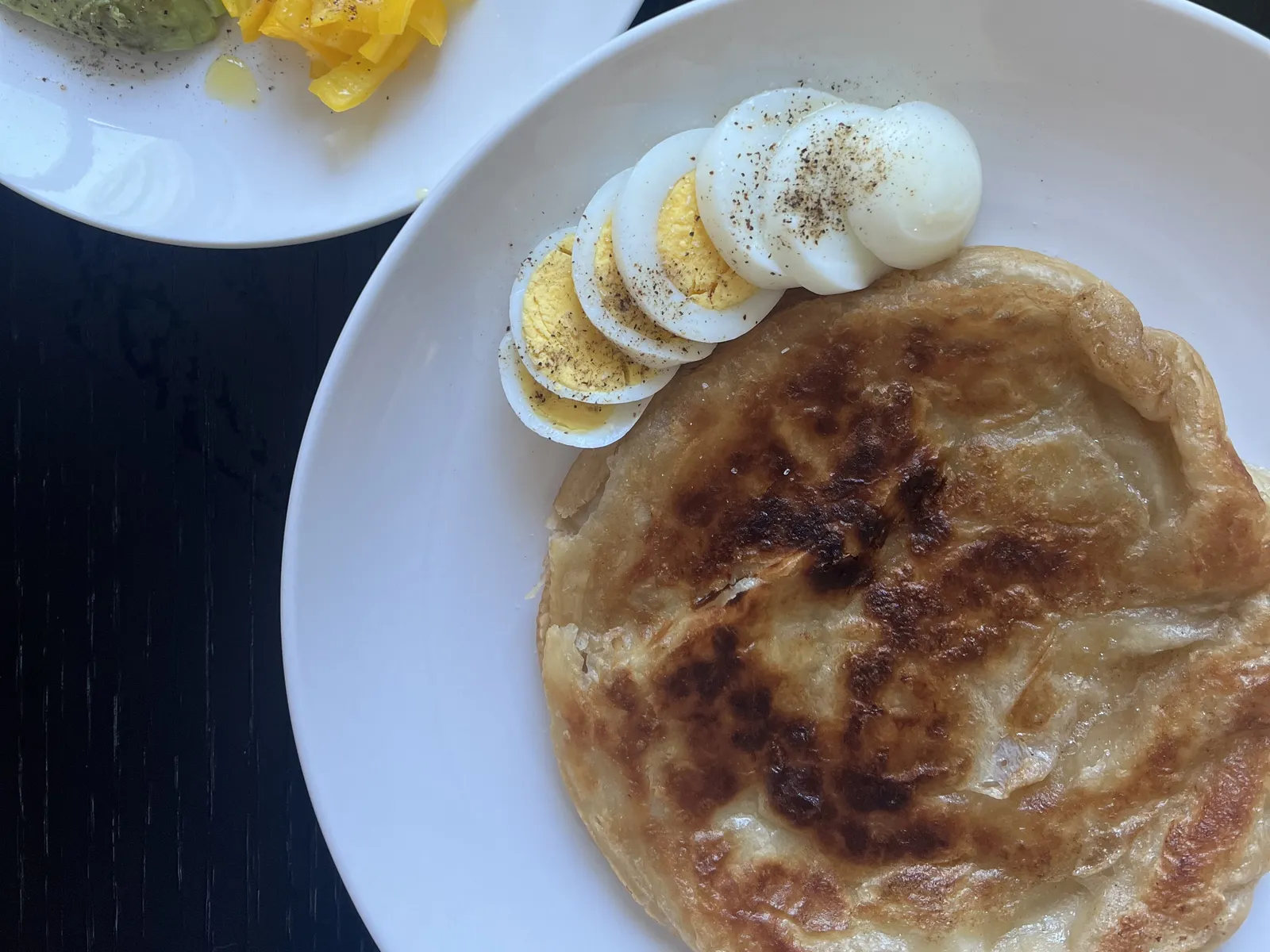
Take one spiral and roll it gently into a round about 24 cm across and 5 mm thick, pressing from the centre outwards so the layers stay even. Melt about 5 g of butter in a large frying pan over medium heat, about 180°C (350°F). Lay in the round and fry for 2–3 minutes per side until deep golden, puffed in places and crisp at the edges, adding a little more butter for each round. Keep the finished breads warm under a clean cloth while you fry the rest.
Medium heat is the whole trick: too hot and the butter burns before the inside cooks; too cool and the bread soaks up fat and turns greasy instead of crisp.
Done when: Deep golden on both sides, visibly layered and flaky at the torn edge, crisp outside and soft inside.
auto_awesome Finishing Touches & Plating
Serve each malawah hot, torn into rough pieces by hand, with the sliced egg, a spoonful of resek and a little zhug on the side. A drizzle of honey over a piece is the traditional sweet finish, and a glass of sweet mint tea completes the plate.

 Yemen
2h
 Vietnam
 France