Curated recipes from 193 countries  •  New seasonal Mediterranean issue out now

Overview

Mille-Feuille

Napoleon Pastry, Vanilla Slice, Gâteau de Mille-Feuilles

Mille-feuille — the name means a thousand sheets — is France's most elegant pastry: three shattering layers of golden puff pastry, two layers of silky vanilla pastry cream, and a marbled icing top. It is a project, not a quick bake, but every step is simple. One serving is about 150 g.

Mille-feuille means a thousand sheets, and layered pastries of this kind appear in French cookbooks from the 1600s. The modern version — three crisp layers of puff pastry with vanilla pastry cream and a marbled icing top — owes much to the great 19th-century chef Marie-Antoine Carême, who refined French pâtisserie into the form we know today. In Britain and Australia the same pastry is called a vanilla slice, and in North America it is often known as a Napoleon.

Pairs well with: Serve with fresh raspberries and a cup of black coffee.

Provenance

France flag France

Paris Pâtisserie

Nordic & European

Time Dedication

1h 25m

60m prep • 25m cook

Batch Yield

6 Servings

514 kcal per serving

1 serving ≈ 150 g

Technical Skill

Advanced

Advanced (Pastry & Cream)

Meal Timing & Digestive Fit

Breakfast

Not Advised

Lunch

Inappropriate

Dinner

Inappropriate

Snack & Tea

Ideal Light Bite

Occasions: Afternoon tea, birthdays, dinner-party desserts, patisserie weekends Cost: Moderate — about $2–3 per serving at home
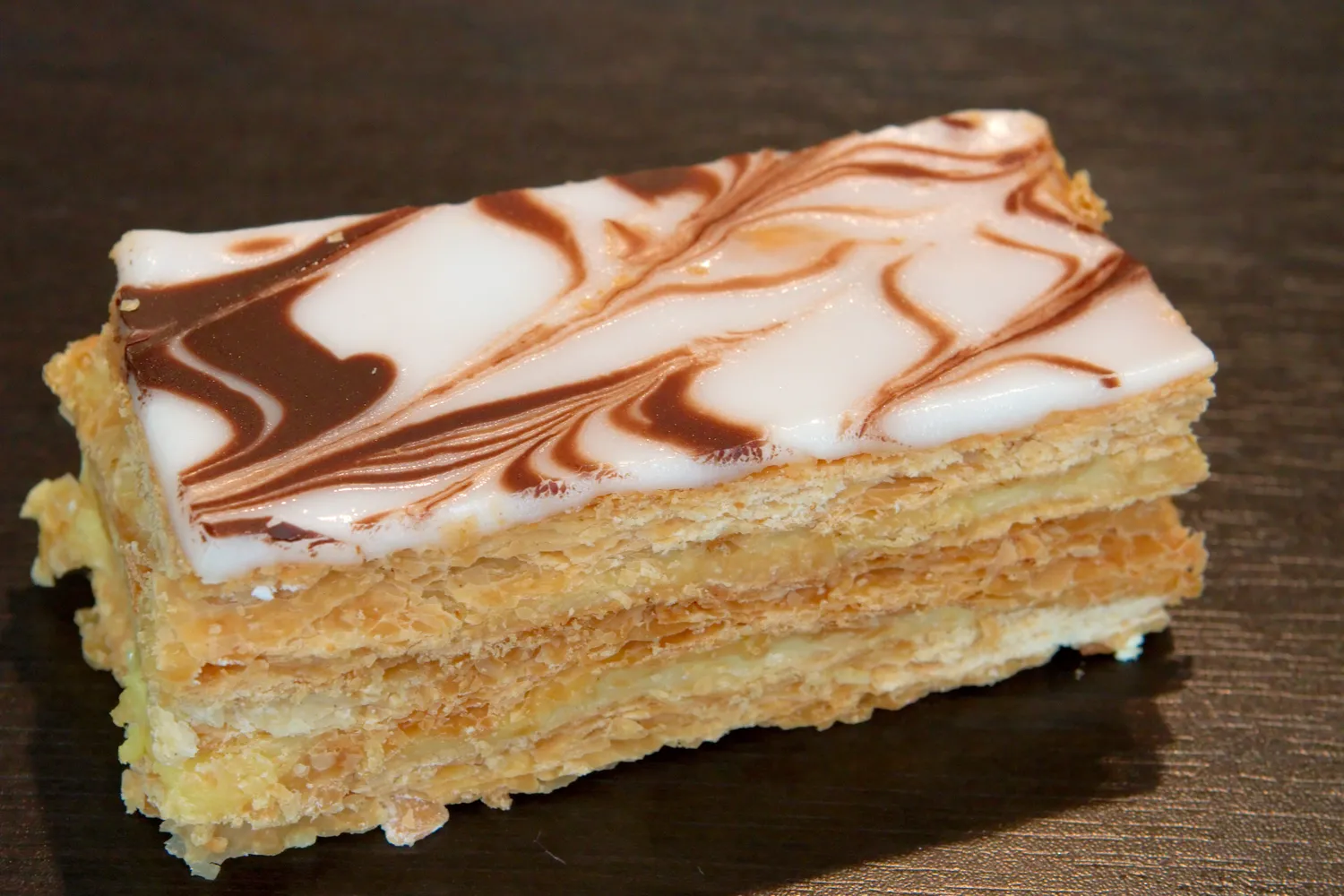
A slice of mille-feuille with marbled icing on top and layers of puff pastry and cream

Paris Pâtisserie

Photo: Georges Seguin (Okki), CC BY-SA 3.0, via Wikimedia Commons

The Heritage Formulary

Measured Ingredients

Estimated cost: Moderate — about $2–3 per serving at home (USD)

Made the classic way: three crisp pastry layers, two layers of vanilla crème pâtissière, marbled icing on top.

Execution Methodology & Culinary Technique

Step-by-Step Cooking Guide

Active 1h 25m
P

Prep Stage: Cream, Pastry & Icing

60 Mins • Cooking, Chilling & Baking

Make the pastry cream first so it can chill while the pastry bakes. Prick and bake the pastry sheets between two trays so they stay flat and crisp. Mix the icing only when you are ready to assemble.

Maestro Tip: Keep the pastry cold right up to the oven — cold butter in the layers is what makes them puff and shatter.

  1. 1

    Make the Pastry Cream

    15 Mins Medium heat, ~175°C (350°F)

    Warm the milk with the vanilla in a pan until it steams. Whisk the yolks, granulated sugar and cornstarch in a bowl until pale, then pour in the hot milk in a slow stream, whisking all the time. Return everything to the pan and cook, stirring constantly, for 3–4 minutes until thick enough to coat a spoon.

    Whisk without stopping once the cream is on the heat — a moment of stillness and the yolks scramble.

    Done when: A thick, glossy cream that holds its shape on a spoon.

  2. 2

    Chill the Cream

    30 Mins Fridge, 4°C (40°F)

    Stir in the butter cubes and the pinch of salt until melted, then scrape the cream into a bowl, press cling film directly onto the surface and chill for at least 30 minutes until cold and firm.

    Film on the surface stops a skin forming — a skin would make lumps in the finished cream.

    Done when: A cold, firm cream that pipes or spreads smoothly.

  3. 3

    Bake the Pastry

    25 Mins 200°C (400°F)

    Heat the oven to 200°C (400°F). Lay the pastry sheets on baking trays, prick all over with a fork, cover with baking paper and a second tray, and bake for 20–25 minutes until deep golden and crisp. Cool completely, then trim each sheet into 3 even rectangles.

    The second tray is the secret: it stops the pastry rising into a pillow and keeps the layers flat and crisp.

    Done when: Deep golden, flat, crisp sheets that snap when bent.

  4. 4

    Assemble the Layers

    10 Mins Room temperature, ~21°C (70°F)

    Lay one pastry rectangle on a board, spread or pipe half the cream over it, and set the second rectangle on top. Spread the rest of the cream, then lay the third rectangle on top and press down very gently.

    Work quickly and gently — the cream softens the pastry if the dessert sits around unassembled.

    Done when: Three straight layers with cream peeking out evenly at the edges.

  5. 5

    Ice and Marble the Top

    5 Mins Room temperature, ~21°C (70°F)

    Mix the icing sugar with 2–3 teaspoons of cold water until it runs in a thick ribbon. Spread it over the top layer, then pipe thin lines of cocoa paste across it and drag a toothpick through them, alternating direction, to make the classic marbled feather pattern. Chill for 15 minutes before slicing with a hot, dry knife.

    A hot knife wiped clean between cuts is the only way to slice through crisp pastry without shattering it.

    Done when: A glossy white top with brown marbled feathers, and clean, straight layers when cut.

Finishing Touches & Plating

Chill for 15 minutes so the icing sets, then slice with a hot, dry knife and serve the same day, while the pastry is still crisp.

Nutritional Physiology & Benefits

Nutrition

Energy

514

kcal / serving

Protein

7g

Complete AA

Carbs

55g

Complex

Fats

30g

Healthy

Per serving (6 servings · 1 serving ≈ 150 g)
Energy514 kcal
Protein7 g
Carbohydrates55 g
Fat30 g
Fibre1.1 g
Sugar27.5 g
Sodium276 mg
Per 100g
Energy342 kcal
Protein4.8 g
Carbohydrates36.4 g
Fat20.1 g
Fibre0.7 g
Sugar18.3 g
Sodium184 mg

Nutrition values are estimated — calculated from USDA FoodData Central values for the listed ingredients.

Vitamins & minerals: Calcium from milk, vitamin A from butter and egg yolk, B vitamins from eggs.

Calcium from Milk

The pastry cream is built on whole milk, which supplies calcium for normal bones and teeth.

Energy for the Afternoon

At about 514 kcal a serving, this is a substantial treat that genuinely fills the gap between lunch and dinner.

Egg Yolk Nutrients

The yolks in the cream supply vitamin A and B vitamins, alongside the milk's calcium.

Food Pairings

What to Eat With

To optimize nutrient absorption and elevate the sensory depth, pair with these authentic accompaniments:

Sides

Fresh Raspberries

Sharp berries cut through the rich cream and sweet icing, and their acidity wakes up the whole pastry.

Drinks

Espresso

A short, strong coffee is the classic French partner for a sweet pastry — the bitterness balances the sugar.

Mint Tea

Light, unsweetened mint tea cleanses the palate between rich, buttery bites.

More Pairings

Vanilla Ice Cream

A small scoop of vanilla ice cream echoes the cream inside and adds a cold contrast to the crisp pastry.

Complete menu

Serve the mille-feuille with fresh raspberries and espresso, follow a light lunch, and finish the afternoon with mint tea.

Digestive Guardrails

What NOT to Combine

To prevent digestive distress, sluggishness, or palate clash, avoid pairing the dish with these elements:

Storing It Assembled Overnight

The cream softens the pastry within hours, so a mille-feuille assembled the night before turns soggy. Assemble on the day you serve it. This is general food information, not medical advice.

Leaving It Out in a Warm Room

The pastry cream is made with milk and egg, so it should not sit out for hours in a warm room — keep the finished pastry chilled until serving. This is general food information, not medical advice.

General information only, not medical advice — consult a doctor for personal dietary decisions.

Who Should Eat It

Who Should Eat

  • General adultsA rich, sweet pastry best enjoyed as an occasional treat rather than an everyday snack.
  • ChildrenChildren love the cream and icing; cut small portions, as it is very sweet.
  • ElderlyServe a small slice with berries; the pastry is crisp and the cream is soft.
  • Pregnant womenThe cream is made with fully cooked egg yolk and milk, but the sugar and fat are high — keep portions small.
  • Breastfeeding womenA satisfying treat; the milk and egg add some nutrition, but it is still a dessert.
  • AthletesA good energy-dense treat after hard training; the sugar gives quick energy.
  • Weight gainAn energy-dense dessert that suits weight gain when eaten as part of a full day's food.
  • Weight lossAt about 514 kcal a slice with high sugar, keep it occasional and share a portion.

Health Conditions — Adjust or Avoid

Conditions

  • DiabetesAbout 54 g of carbohydrate and 27 g of sugar per serving — a large load; eat a small portion and ask your clinician if unsure.
  • High blood pressureThe sodium is modest, but the sugar and fat are high; keep portions small and ask your clinician if unsure.
  • Kidney diseaseMilk, egg and butter make this a rich dessert; eat it rarely and ask your clinician if unsure.
  • GoutButter, egg yolk and milk carry purines and fat; keep portions small and ask your clinician if unsure.
  • Stomach issuesButter, cream and sugar can be heavy on a sensitive stomach; eat a small slice slowly and ask your clinician if unsure.
  • Cardiovascular diseaseHigh in sugar and saturated fat, so this is an occasional treat at most — ask your clinician if unsure.
  • Fatty liverA rich, sugary dessert; keep it rare and small, and ask your clinician if unsure.
  • Food allergiesContains wheat (pastry), milk, egg and butter; the cocoa may affect people with a cocoa sensitivity.
  • Special therapeutic dietsHigh in sugar and fat, so it rarely fits a therapeutic diet — ask your clinician before eating it.

If you have a medical condition, consult your doctor before changing your diet.

Storage & Use

Storage & Use

How to store
Keep in a covered container in the fridge; store unassembled pastry and cream separately if you can.
In the fridge
Assembled mille-feuille keeps 1 day in the fridge at 4°C (40°F) or below, but the pastry softens.
In the freezer
Not recommended — the pastry turns soggy and the cream splits on thawing.
How to reheat
Do not reheat; serve chilled. Reheating melts the cream and softens the pastry.
Freezing recommended
No.
Signs it has spoiled
Sour smell from the cream, soft or damp pastry, or any mould.

More recipes to explore

Golden butter croissants on a wooden board France flag France 20m
Breakfast •Parisian Boulangerie

Croissant au Beurre & Café

Laminated cultured butter pastry paired with washed Arabica, for a slow, pleasurable Parisian morning — best with a little protein alongside. One serving is about 390 g.

Sustained Focus

Flaky all-butter croissant with café au lait, Comté and green apple.

Pairs Well With
Comté cheese wedge & Green apple slices
Quick Prep (<30m)
Bœuf bourguignon — French beef braised in red wine France flag France 4h
Dinner •Burgundy Terroir

Bœuf Bourguignon

Beef braised gently in red wine until the connective tissue melts into a velvet, gelatin-rich sauce — the classic Burgundy Sunday dinner.

Cellular Repair

Beef braised in red wine until spoon-tender, with mushrooms and pearl onions.

Pairs Well With
Parsnip Purée & Steamed French Haricots Verts
High Protein
A mound of classic ratatouille with eggplant, zucchini, tomato and onion on a white plate France flag France 1h 15m
Dinner •Nice Provençal

Ratatouille

This ratatouille recipe cooks eggplant, zucchini, peppers and tomatoes separately first, so each vegetable keeps its own texture, then brings them together for a slow, fragrant simmer. One serving is about 400 g.

Light & Vegetable-Rich

Slow-simmered summer vegetables in olive oil — light, fragrant and full of fibre.

Pairs Well With
Crusty sourdough bread, grilled fish or a fried egg
A bowl of coq au vin with a braised chicken leg in dark red wine sauce with mushrooms and onions, greens on the side France flag France 1h 40m
Dinner •Burgundy Classic

Coq au Vin

This coq au vin recipe is the Burgundy classic: chicken thighs browned with bacon, then braised in red wine with mushrooms, pearl onions and carrots until the meat is tender and the sauce is dark and glossy. One serving is about 375 g. It takes 1 hour 40 minutes, most of it hands-off while the pot simmers.

Comfort & Warmth

Chicken braised slowly in red wine with mushrooms, pearl onions and bacon until it falls off the bone.

Pairs Well With
Mashed potatoes, crusty bread & Burgundy wine

The Dinner Gazette

Never wonder what’s for dinner again

One email a week with easy dinner ideas from around the world — ingredients, steps and nutrition, tested in our kitchen first.

Delivered every Thursday morning. Unsubscribe anytime.