Curated recipes from 193 countries  •  New seasonal Mediterranean issue out now

Overview

Saudi Kleeja

Kleija, Qassimi Kleeja, Saudi cardamom cookies

This kleeja recipe makes 24 golden, dome-shaped Qassimi cookies: a yeasted whole-wheat dough spiced with cardamom and cinnamon, wrapped around a sugar, dried-lime and spice filling that melts into caramel as it bakes. Each cookie is pressed with a patterned mould, brushed with egg, and baked until crisp outside and soft inside. One serving is about 120 g (3 cookies).

Kleeja comes from Al-Qassim in the Najd heartland, where families bake it for Eid and weddings — tradition holds that on the morning after a wedding, the bride's family carries trays of kleeja to the groom's family. The town of Buraidah in Qassim holds an annual kleeja festival celebrating the cookie. The sugar-and-loomi filling is the Qassimi signature: as the cookies bake, the sugar melts into a spiced caramel inside the dome. A date-paste filling is the other common version, and many families make both.

Pairs well with: Arabic coffee or mint tea, with labneh on the side

Provenance

Saudi Arabia flag Saudi Arabia

Saudi Heritage

Middle Eastern

Time Dedication

2h 15m

110m prep • 25m cook

Batch Yield

8 Servings

400 kcal per serving

1 serving ≈ 120 g

Technical Skill

Intermediate

Intermediate (Filled & Moulded)

Meal Timing & Digestive Fit

Breakfast

Not Advised

Lunch

Inappropriate

Dinner

Inappropriate

Snack & Tea

Ideal Light Bite

Occasions: Eid, Weddings, Afternoon tea, Family gatherings Cost: Low — about $4 per batch, under $1 per serving at home
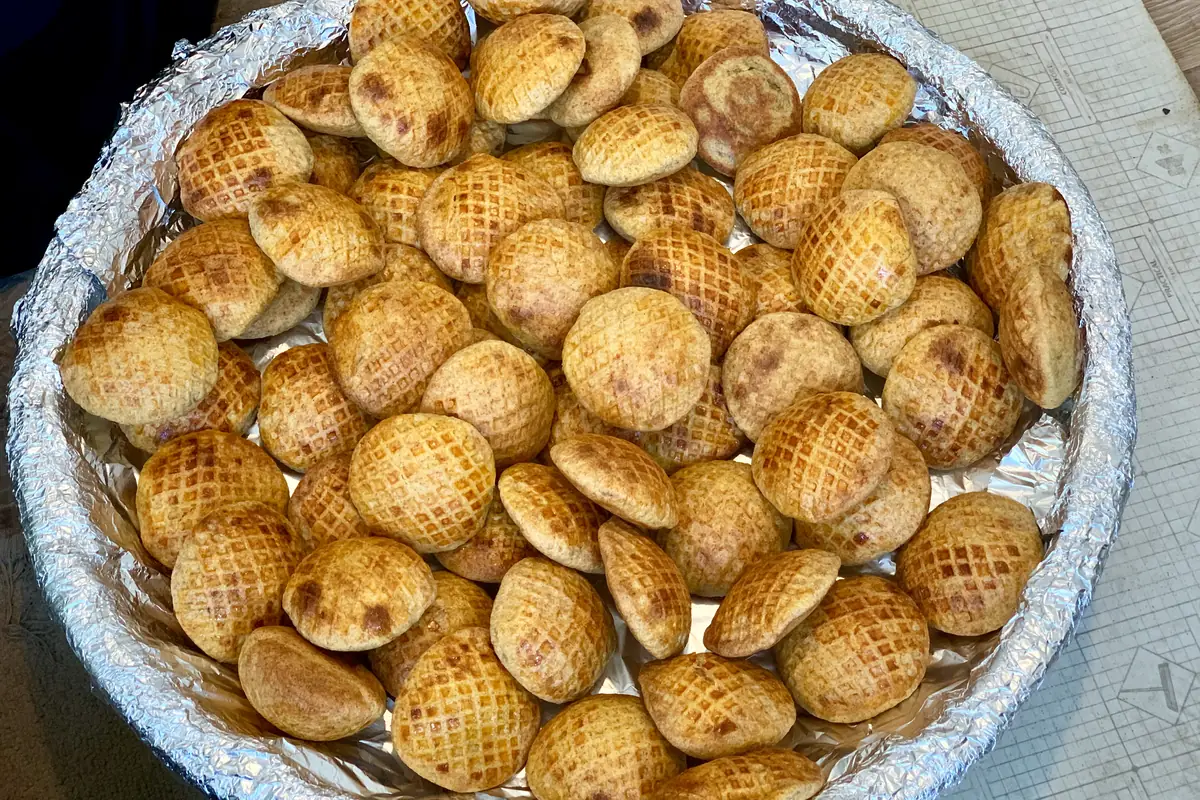
A foil-lined tray piled with golden kleeja cookies, each dome pressed with a crosshatch pattern

Saudi Heritage

Photo: Slayym, CC BY-SA 4.0, via Wikimedia Commons

The Heritage Formulary

Measured Ingredients

Estimated cost: Low — about $4 per batch, under $1 per serving at home (USD)

A good kleeja is judged by its dome: crisp, golden and clearly patterned, with the spiced sugar melted into caramel inside rather than leaking out.

Execution Methodology & Culinary Technique

Step-by-Step Cooking Guide

Active 2h 15m
P

Prep Stage: Dough, Filling & Mould

1 Hour 50 Mins • Kneading & Shaping

Knead the spiced dough until smooth, then cover and leave it to rise for 1 hour until doubled. While it rises, mix the filling: sugar, ground dried lime, cardamom, cinnamon and softened butter rubbed together until it clumps like damp sand. Have a kleeja mould (or the back of a patterned glass) and a lined baking tray ready before you start shaping.

Maestro Tip: Do not rush the rise — an under-risen dough bakes dense and heavy instead of light and crisp.

  1. 1

    Mix and Knead the Dough

    15 Mins + 1 Hour Rise Warm milk at 40°C (104°F)

    Sprinkle the yeast over the warm milk and leave 5 minutes until foamy. In a large bowl, mix the whole wheat flour, plain flour, 30 g sugar, 6 g cardamom, 4 g cinnamon and salt. Pour in the yeasted milk and the melted butter, then knead for about 10 minutes, adding the warm water a spoonful at a time, until the dough is smooth, soft and no longer sticky. Cover the bowl with a damp cloth and leave in a warm place for 1 hour, until doubled in size.

    The milk must feel warm on your wrist, not hot — water above 46°C (115°F) kills yeast and the dough will not rise.

    Done when: Dough has doubled in size and springs back slowly when poked with a fingertip.

  2. 2

    Make the Spiced Sugar Filling

    5 Mins No heat — room temperature, about 20°C (68°F)

    In a small bowl, mix the 100 g filling sugar with the ground dried lime, 3 g cardamom and 3 g cinnamon. Rub in the 15 g softened butter with your fingertips until the mixture clumps together like damp sand. Set aside — this is the filling that melts into caramel inside the cookies.

    Taste a pinch: it should be sweet first, then warmly spiced, with a clear sour edge from the dried lime.

    Done when: The mixture holds together when squeezed and smells sharply of lime and cardamom.

  3. 3

    Fill and Shape the Domes

    20 Mins No heat — room temperature, about 20°C (68°F)

    Knock the risen dough back gently and divide it into 24 equal pieces, about 40 g each. Flatten one piece in your palm into a round about 8 cm across, place 1 teaspoon of filling in the centre, then gather the edges up and pinch firmly to seal. Roll the sealed ball gently between your palms until smooth, with the seam underneath, and place it seam-side down on a lined baking tray. Repeat with the remaining dough, spacing the balls about 4 cm apart.

    Seal the edges tightly — any gap lets the melted sugar leak out in the oven and burn on the tray.

    Done when: 24 smooth, even balls with no visible filling and no cracks.

  4. 4

    Press the Pattern and Egg Wash

    10 Mins No heat — room temperature, about 20°C (68°F)

    Press each ball gently with a kleeja mould, a patterned glass, or the back of a fork to flatten it into a dome about 6 cm across and stamp the signature crosshatch pattern on top. Brush each dome lightly with the beaten egg — just enough to shine, without pooling in the pattern. Heat the oven to 180°C (350°F) while you work.

    Press straight down and lift cleanly; twisting the mould tears the pattern and can split the seal.

    Done when: Every dome is evenly flattened, clearly patterned, and lightly glossed with egg.

  5. 5

    Bake Until Golden

    25 Mins 180°C (350°F)

    Bake the tray in the centre of the oven for 20–25 minutes, turning the tray once halfway through, until the domes are deep golden brown and the pattern lines are a shade darker. The filling inside will be molten, so leave the cookies on the tray for 10 minutes before moving them to a wire rack — they firm up as they cool and the sugar sets into caramel.

    Check at 20 minutes: kleeja goes from golden to burnt quickly, so pull the tray as soon as the tops are evenly browned.

    Done when: Domes are deep golden with darker pattern lines, crisp at the edges, and firm enough to lift without bending.

Finishing Touches & Plating

Cool the kleeja on a wire rack for at least 15 minutes before serving — the filling is molten sugar straight from the oven and needs time to set into caramel. Serve warm or at room temperature, piled on a tray, with Arabic coffee or tea.

Nutritional Physiology & Benefits

Nutrition

Energy

400

kcal / serving

Protein

10g

Complete AA

Carbs

66g

Complex

Fats

12g

Healthy

Per serving (8 servings · 1 serving ≈ 120 g)
Energy400 kcal
Protein10 g
Carbohydrates66 g
Fat12 g
Fibre6.1 g
Sugar17.8 g
Sodium265 mg
Per 100g
Energy333 kcal
Protein8.1 g
Carbohydrates55 g
Fat10.3 g
Fibre5.1 g
Sugar14.9 g
Sodium221 mg

Nutrition values are estimated — calculated from USDA FoodData Central values for the listed ingredients.

Vitamins & minerals: B vitamins (thiamin, niacin) and iron from whole wheat flour, manganese from cinnamon and cardamom, and calcium from milk and butter. Nutrition values are estimated.

Whole-Grain Fibre

Whole wheat flour gives about 6 g of fibre per serving, which supports normal digestion and helps the cookies feel filling.

Steady Snack Energy

At 400 kcal a serving, with complex carbohydrates from the flour and fat from the butter, kleeja makes a substantial snack that keeps you going between meals.

Warming Spices, No Additives

Cardamom, cinnamon and dried lime bring all the flavour — this recipe uses no artificial colours, flavours or preservatives.

Food Pairings

What to Eat With

To optimize nutrient absorption and elevate the sensory depth, pair with these authentic accompaniments:

Drinks

Arabic Coffee (Qahwa)

The classic pairing: bitter, lightly cardamom-spiced coffee balances the sweet caramel filling, and the two share the same spice language — this is how kleeja is served at Eid and weddings.

Fresh Mint Tea

Hot mint tea cuts through the butter-rich crumb and refreshes the palate between cookies, so the sweetness never feels heavy.

Sides

Labneh with Honey

Cool, tangy labneh contrasts with the warm, sweet cookie, and a thin drizzle of honey echoes the caramel inside without doubling the sugar load.

Sliced Pears or Figs

Fresh fruit adds moisture, gentle acidity and crunch beside a dry, crumbly cookie, and its natural sweetness lets you stop at one or two kleeja.

Complete menu

Serve a tray of kleeja as the centrepiece of an afternoon coffee spread with Arabic coffee, fresh mint tea and a bowl of labneh, followed by sliced pears or figs to finish.

Digestive Guardrails

What NOT to Combine

To prevent digestive distress, sluggishness, or palate clash, avoid pairing the dish with these elements:

A Second Sweet Straight After

One serving already carries about 18 g of sugar from the filling, so following kleeja with dates in syrup, sweetened drinks or dessert stacks sugar quickly and can spike blood glucose. Enjoy the cookies, then keep the rest of the meal savoury. This is general information, not medical advice — ask your clinician about your own diet.

Eating Them Piping Hot

Straight from the oven the filling is molten sugar, which can burn the mouth badly. Always let kleeja cool for at least 15 minutes so the filling sets into caramel before eating. This is general information, not medical advice.

General information only, not medical advice — consult a doctor for personal dietary decisions.

Who Should Eat It

Who Should Eat

  • General adultsA satisfying festive snack — enjoy 2–3 cookies with coffee or tea as an afternoon treat.
  • ChildrenSuitable as an occasional treat; serve 1 cookie, cooled completely, and keep the portion small because of the sugar.
  • ElderlyGood with tea if teeth allow — the cookie is firm and crisp, so serve with a hot drink to soften each bite, and keep portions modest.
  • Pregnant womenGenerally suitable in small portions; the egg is fully baked through and the spices are used in normal food amounts.
  • Breastfeeding womenGenerally suitable as a snack; the whole-grain dough and milk provide steady energy between feeds.
  • AthletesA useful quick energy snack after training — about 66 g of carbohydrate per serving — but pair it with protein, as kleeja alone is low in protein.
  • Weight gainA good choice — energy-dense at 400 kcal per serving, easy to eat, and pleasant with calorie-rich drinks like sweetened milk tea.
  • Weight lossEnjoy one cookie (about 133 kcal) with unsweetened tea rather than a full serving, and stop there — the sugar filling makes it easy to overeat.

Health Conditions — Adjust or Avoid

Conditions

  • DiabetesHigh in sugar and refined carbohydrate — limit to one cookie (about 133 kcal, 22 g carbohydrate) and pair with unsweetened tea; ask your clinician about portion size.
  • High blood pressureSodium is moderate at about 265 mg per serving, but the sugar load is the bigger concern; keep the portion small and ask your clinician if unsure.
  • Kidney diseaseThe phosphorus and potassium from whole wheat flour add up in larger portions; eat occasionally and in small amounts, and ask your clinician about portion size.
  • GoutLow in purines, so the cookie itself is not a typical trigger; the sugar load is the main reason to keep portions small. Ask your clinician if unsure.
  • Stomach issuesThe dried lime is acidic and the spices can irritate a sensitive stomach; eat a small portion after food rather than on an empty stomach, and stop if it causes discomfort.
  • Cardiovascular diseaseButter brings saturated fat, so treat kleeja as an occasional festive food rather than a daily snack, and keep portions small. Ask your clinician about your own diet.
  • Fatty liverThe sugar filling is the main concern — added sugar is best limited, so enjoy one cookie on special occasions rather than a full serving. Ask your clinician if unsure.
  • Food allergiesContains gluten (wheat), egg and milk (butter, milk). Not suitable for coeliac disease or wheat, egg or milk allergy. The date-paste variation may contain nuts — check the filling if you have a nut allergy.
  • Special therapeutic dietsIf you follow a prescribed low-sugar, low-sodium or gluten-free diet, this recipe does not fit as written — ask your clinician or dietitian before adapting it.

If you have a medical condition, consult your doctor before changing your diet.

Storage & Use

Storage & Use

How to store
Cool completely, then store in an airtight container at room temperature.
In the fridge
Up to 2 weeks in an airtight container; bring back to room temperature before serving.
In the freezer
Up to 3 months in a sealed freezer bag.
How to reheat
Warm in a low oven at 150°C (300°F) for 5 minutes until heated through.
Freezing recommended
Yes — freeze in a single layer first, then bag for up to 3 months; thaw at room temperature.
Signs it has spoiled
Stale, cardboard taste, rancid smell from the butter, or mould spots — discard if any appear.

More recipes to explore

Saudi mandi — whole roasted chickens on orange-tinted smoked rice, with bowls of soup alongside Saudi Arabia flag Saudi Arabia 2h
Dinner •Saudi Heritage

Saudi Mandi

This mandi recipe is Saudi Arabia's great smoked feast dish: the chicken is rubbed with a cumin and coriander spice mix and slow-roasted until the skin is crisp and the meat carries a real charcoal smoke flavour, while the basmati rice is cooked separately in the drippings and stock from the roasting pan. That separation is the whole point of mandi — the meat is never cooked in the rice, as it is in kabsa, so the rice stays pale and fluffy and the chicken stays smoky. One serving is about 450 g.

Smoky Pit-Roasted Feast

Chicken slow-roasted until smoky and tender, served over basmati rice cooked separately in the meat drippings.

Pairs Well With
Mandi soup, salata & hot black tea
High Protein
Saudi jareesh — creamy cracked-wheat porridge in a pot topped with dark fried onions Saudi Arabia flag Saudi Arabia 2h 10m
Dinner •Saudi Heritage

Saudi Jareesh

This jareesh recipe is Saudi Arabia's old cracked-wheat porridge: coarse cracked wheat is soaked, then simmered with chicken, onion, tomato and cumin until the grains soften and the whole pot turns thick and creamy, with the chicken shredded through it. It is finished the Saudi way, with melted ghee and a spoonful of crisp, dark fried onions on top. It is not beaten smooth like harees — the cracked wheat keeps a soft, visible grain. One serving is about 375 g.

Slow-Cooked Comfort & Gentle Energy

Cracked wheat and chicken simmered slowly until creamy, finished with ghee and crisp fried onions.

Pairs Well With
Cucumber and tomato salad, lentil soup & hot tea
Soups & Broths
Pan con tomate with jamón ibérico on toasted bread Spain flag Spain 15m
Snack & Tea •Catalan Aperitivo

Pan con Tomate & Jamón Ibérico

Country bread rubbed with ripe Ramallet tomato, drizzled with cold-pressed Arbequina olive oil and topped with jamón ibérico.

Vascular Health

Toasted tomato bread with jamón ibérico, olive oil and olives.

Pairs Well With
Castelvetrano Olives & Sparkling Mineral Water
Quick Prep (<30m)
Gỏi cuốn — Vietnamese fresh spring rolls with prawn and pork Vietnam flag Vietnam 1h 5m
Snack & Tea •Saigon Refresh

Gỏi Cuốn Tôm Thịt

Fresh rice paper rolls filled with poached prawns, tender pork, rice vermicelli, lettuce, herbs and carrot, served with a peanut dipping sauce.

Light Digestion

Nothing is fried, so the rolls stay light and fresh — a cool, herb-filled snack for hot days.

Pairs Well With
Artisanal Peanut Dip & Fresh Lotus Root Water
High Protein

The Dinner Gazette

Never wonder what’s for dinner again

One email a week with easy dinner ideas from around the world — ingredients, steps and nutrition, tested in our kitchen first.

Delivered every Thursday morning. Unsubscribe anytime.